
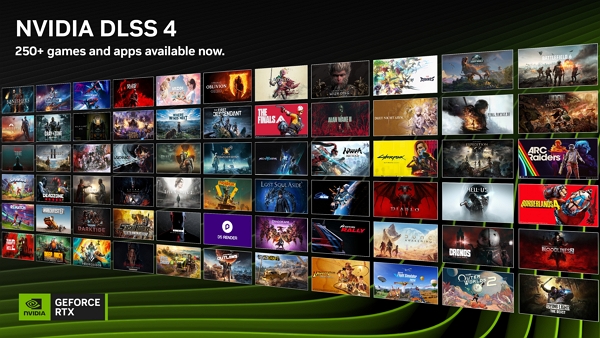
Is running a game at native 4K resolution really the best choice for image quality? A recent blind comparison test has put the debate back in focus after upscaling technology came out ahead of native-resolution quality.
On Feb. 19, TechRadar reported that German IT outlet ComputerBase conducted a blind test comparing Nvidia DLSS 4.5 (quality) and AMD FSR 4 (quality) with native 4K (with TAA applied). The content was introduced via Tom's Hardware.
The test was run without displaying the technology names in the video, and participants could select only 1 option they judged to have the best image quality. All upscaling was set to quality mode rather than performance mode, and native 4K used temporal anti-aliasing, or TAA. TAA is the most common anti-aliasing technique in modern 3D games, blending data from previous and current frames to minimise aliasing and shimmering.
The comparison used 6 games: Anno 117, Arc Raiders, Cyberpunk 2077, Horizon Forbidden West, Satisfactory and The Last of Us Part II. More than 6,700 votes were tallied over about 2 weeks. Participants were instructed to download the original file and review it with Nvidia's ICAT player, rather than using YouTube streaming, to minimise distortion from compression loss.
The final results showed a clear advantage for DLSS. Nvidia DLSS 4.5 ranked first with 48.2 percent of the total vote, while native 4K ranked second with 24 percent. Only 15 percent said AMD FSR 4 was best, and 12.8 percent said they did not feel a meaningful difference among the 3 technologies. In particular, DLSS received a majority of selections in Satisfactory (60.9 percent) and Horizon Forbidden West (56.3 percent).
The closest contest came in Cyberpunk 2077. DLSS received 34.4 percent and native 4K 32.4 percent, a narrow gap, while 22.6 percent chose a tie, suggesting the perceived differences among the technologies were not large. AMD FSR 4's best result was 25.3 percent in The Last of Us Part II, but it still trailed native (25.9 percent) and DLSS (40.9 percent).
The results suggest the latest upscaling technology is not limited to improving frame rates and can compete with native 4K on image quality, or even surpass it in some environments. But because the vote required choosing only the single best option, the gaps between second and third place were not fully reflected, leading to a view that it is difficult to conclude FSR is inferior to native resolution.
Even so, the blind test is seen as an example showing DLSS is still regarded as the benchmark for upscaling technology. It also suggests competition will intensify as AMD's FSR 4 is seen as having made considerable progress compared with the previous generation.
 Jinju Hong
hongjj@d-today.co.kr
Jinju Hong
hongjj@d-today.co.kr