
As the Middle East war enters its fourth week and concerns grow about a prolonged conflict, volatility in oil prices and the exchange rate has emerged as a key variable for South Korean stocks. Markets look subdued, with short selling and inflows into inverse products rising sharply. But experts see market fear as already past its peak.
On March 22, the Korea Financial Investment Association said indicators are showing investors moving in expectation of a stock market decline. Securities lending balances, seen as a leading indicator of short selling, rose sharply in the third week of March.
The balance stood at 144.6 trillion won on March 16 and jumped to 154.0 trillion won on March 18. It was 149.3 trillion won as of March 19, well above this month’s average of 143.7 trillion won.
Net short positions on the KOSPI have also hit a record high at 15.37 trillion won, supporting a pessimistic market outlook.
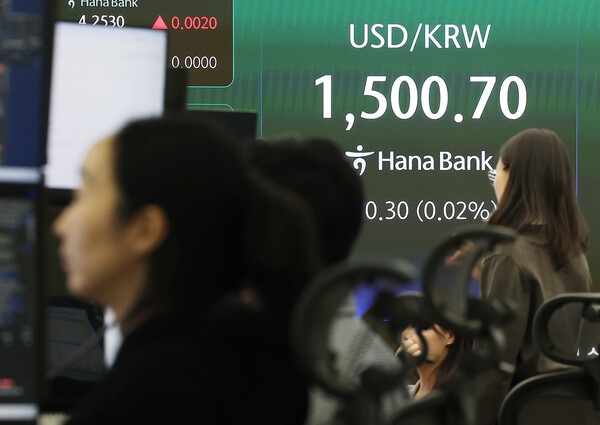
As the war moves into a prolonged phase, a rise in international oil prices is stoking global inflation expectations. The won-dollar exchange rate has also risen steeply, recently breaking past the 1,500 won level, in a period of extreme volatility.
Foreign investors are likely to stay on the sidelines on supply and demand concerns or maintain a net selling bias, wary of foreign exchange losses from these swings. Foreign investors have dumped more than 29.0 trillion won worth of stocks over the past month.
If the surge in oil prices eases, the exchange rate could see a temporary pullback. But unless uncertainty over the war is resolved, a strong-dollar trend is expected to weigh on stocks for the time being.
At the government level, authorities are rolling out market stabilisation measures to respond to such external shocks. Financial authorities have recently launched a 100.0 trillion won market stabilisation programme and say they will respond with zero tolerance to the spread of fake news or acts that disrupt prices.
Future stock market moves are entirely dependent on how the war develops and how oil prices move in response. After the KOSPI broke above 5,900 and then slid to 5,700 as it was exposed to external headwinds, swings have intensified, and a cautious approach that uses volatility is seen as necessary this week as well.
A financial investment industry official said, “Volatility in South Korean stocks has become very large because of the Middle East issue, but we see our companies’ fundamentals as still solid.” The official said, “We judge that the fear sentiment spreading in the market is past its peak.”
The official added, “From a past 기준, the 5,000 level corresponds to a very cheap price, and that means the market has already priced in a lot of the shock from geopolitical risk.” The official added, “If the Middle East issue does not drag on for more than three months, we can look for a chance to change the trend.”
 Sangyeop Oh
yub@d-today.co.kr
Sangyeop Oh
yub@d-today.co.kr