
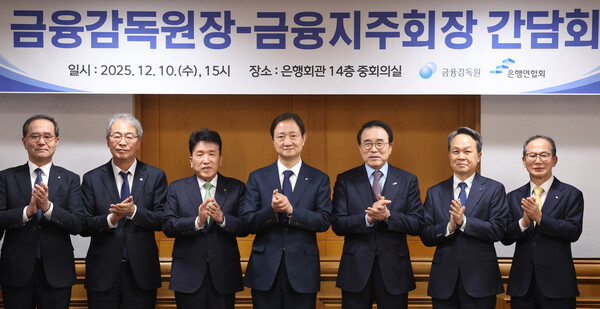
Major South Korean financial holding companies and banks have defined 2026 as the first year of a “financial paradigm shift.” Common keywords include faster digital transformation centered on artificial intelligence (AI), expansion of productive finance, and stronger financial consumer protection and internal controls. The message is interpreted as a pledge to pre-empt structural changes that will determine survival over the next 10 years, beyond simple performance management.
KB Financial: “Transition and expansion…setting the next 10 years”
KB Financial Group presented its 2026 management strategy direction as “Transition & Expansion.” It plans to maintain existing strengths while shifting the way it does business and expanding customers and markets amid the spread of AI and faster capital movement.
To make productive finance a strategic growth opportunity, it will enhance feasibility assessment and risk management capabilities. It will also pursue a shift in its business structure toward advisory and consultation-centered wealth management and capital-efficient investment banking business. It also made clear it will redefine inclusive finance as its core business and place financial consumer protection, beyond regulatory compliance, as the top value in all processes.
KB Kookmin Bank also presented “expansion and transition” as key keywords. It plans to reorganize around corporate finance and wealth management rather than remain in retail finance and to strengthen high value-added consulting capabilities by using AI agents. It also said it will expand support for national strategic industries centered on a dedicated growth-finance unit and make internal controls and information protection the foundation of trust competitiveness.
Shinhan Financial: “AX is a survival task…bold execution for future finance”
Shinhan Financial Group set 2026 as the year to execute its mid- to long-term strategy, “Great Challenge 2030.” Its management slogan is “Bold execution toward future finance.”
Shinhan Financial defined AX and DX not as tools to improve profitability but as conditions for survival, and stressed fundamental innovation across work methods and customer touchpoints. It also presented as key tasks the advancement of a One WM system between its bank and securities unit, a strategy specialized for senior customers, and expanded synergies in insurance and asset management.
It plans to make capital-market competitiveness a key growth engine and to pursue investment in innovative companies and an improvement in economic vitality through productive finance. It also plans to further strengthen internal controls and financial consumer protection as an extension of its founding ideal of a “reliable bank.”
Shinhan Bank shared the same stance. Even amid an uncertain global economic environment, it presented expansion of productive and inclusive finance as the bank’s intrinsic role. Its strategy is to secure future competitiveness through AI-based channel innovation, preparation for new businesses including digital assets, platforms and P2P, and targeting senior and foreign customer segments. At the same time, it stressed realizing a “trusted bank” through establishing a responsibility structure and responding to financial incidents with a prevention focus.
Hana Financial: “Need innovation to change the game, not stopgaps”
Hana Financial Group’s New Year message was marked by a strong sense of crisis that “this cannot go on.” It defined AI, money moves and a shift toward a capital-market-centered structure not as temporary changes but as a fundamental paradigm shift, and assessed that innovation on the level of redesign is needed.
It presented as key tasks a shift toward productive finance, stronger wealth management and investment banking capabilities, and a redesign of the risk management system. It also said it will push consumer protection and enhanced internal controls at a reform level, including eradicating misselling and responding to voice phishing with preventive measures.
In particular, it cited the possibility of institutionalizing digital assets such as won-denominated stablecoins as a major variable and stressed that it should lead the market not as a simple participant but as a “rule designer.”
Woori Financial: “Future shared growth…AX, productive finance, synergy”
Woori Financial Group set its 2026 management goal as “Woori Financial leading future shared growth.” It presented three strategic pillars: productive finance, company-wide promotion of AX, and creation of group synergies.
In particular, it plans to expand investment and financing support by growth stage based on its strengths in corporate finance, while pursuing inclusive finance and preventive consumer protection in parallel. Key tasks also include enhancing AI-based screening, consulting and internal controls, and responding to institutional changes in digital assets. It envisions creating a sustainable growth structure through comprehensive financial synergies spanning banking, insurance and securities.
Woori Bank set its management goal as “growth with customers” and made expanding its customer base the top task. It stressed improving the quality of earnings through expanding productive finance and cooperation with affiliates, as well as strengthening individual capabilities to respond to a changing work environment and principles of responsible management.
NH Nonghyup Bank: “Growth through financial innovation”
NH Nonghyup Bank also presented advancement of AX, expansion of productive finance and zero financial incidents as key tasks through its 2026 management strategy. It set its 2026 management goal as “a national bank that nurtures the future of South Korea.”
Through hyper-personalized finance, it plans to strengthen a comprehensive wealth management strategy spanning customer assets, spending and debt. In productive finance, it plans to speed up support for recovery and growth in the real economy based on its nationwide sales network and field-focused sales.
It will also pursue stronger profitability and soundness. It plans balanced growth of interest and non-interest income by advancing non-face-to-face platforms and data-based sales capabilities, and it set a goal of zero financial incidents through principle-based internal controls and financial consumer protection.
In particular, Nonghyup Bank formalized a shift to an “Agentic AI Bank.” It plans to make AI a core axis of judgment and execution, not simply a tool for work efficiency, and to build a virtuous cycle in which data and field experience further enhance AI performance.
Nonghyup Central Federation also defined 2026 as a turning point for structural transformation in agriculture and rural communities, and said it will concentrate organizational capabilities on restoring agricultural value centered on the “Nongsim Cheonsim Movement” and shifting to “profit-making agriculture.” It also made clear that AX and productive finance strategies of its financial affiliates will be pursued under the shared goal of supporting agriculture and rural communities.
Financial authorities: “Accelerate a major financial shift…deliver results in productive finance”
Financial holding companies and banks are racing to present AI, productive finance and trust recovery as core strategies, linked to the policy stance of financial authorities.
The Financial Services Commission chairman and the Financial Supervisory Service chief also stressed, in their New Year addresses, accelerating a major financial shift and creating results from productive finance, drawing attention to whether the financial sector as a whole can execute strategies and deliver results in 2026.
Financial Supervisory Service Governor Lee Chan-jin stressed: “We will support the sustainable growth of our economy by protecting financial consumers and ensuring financial market stability, and further by successfully transitioning to productive finance.”
Financial Services Commission Chairman Lee Eok-won also said: “We will push forward at speed a major financial shift that leads a great leap forward for the South Korean economy.” He added: “We will start producing results in productive finance in earnest and carry out without gaps our basic duties of expanding inclusive finance, ensuring financial stability and protecting consumers.”
 Lee Ji-young
ljy@d-today.co.kr
Lee Ji-young
ljy@d-today.co.kr