
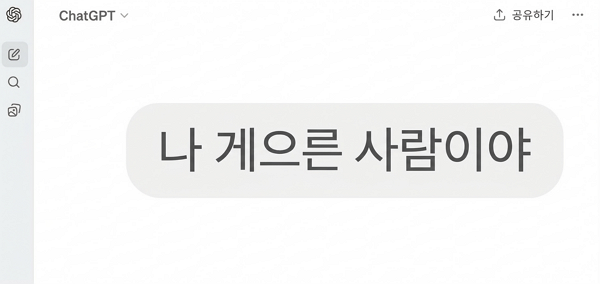
[DigitalToday intern reporter Kyung-min Hong (홍경민)] A striking prompt technique is drawing attention for quieting ChatGPT’s chatter, which can obscure the point with long explanations, by introducing yourself as a very “lazy person.”
Tech outlet TechRadar reported on Thursday that ChatGPT tends to list excessive details regardless of what a question is asking. But if a user specifies during a question that they are lazy, it can change the quality of the answer in a more practical direction. The strategy nudges the AI to remove unnecessary context and extract only the most essential information.
In real-world examples, the difference appears immediately. If you ask for a pasta recipe, you get a detailed step-by-step explanation including cooking time, water ratios and seasoning tips. If you add the qualifier “lazy person,” the answer becomes extremely simple. It offers advice that leaves only a bare framework, such as boiling water, adding a little salt, dropping in the pasta, stirring once, draining when cooked and eating it.
The same effect appears in complex tasks such as work management. When asked to help plan a day, the AI would normally list hourly time blocks and productivity tips. With that prompt, it offers a blunt conclusion: pick only 3 tasks to do first and ignore the rest. This approach makes the essential information clearer, which had been buried inside a long and complex answer structure. It also helps users save the energy needed to review the extensive schedules the AI proposes and focus on work immediately.
What is interesting is that the technique does not simply shorten responses, but reshuffles the priority of information itself. ChatGPT is trained to provide all information without omission, so it often adds excessive explanation. But if it perceives the user as someone who does not want to look into details, the model starts pursuing clarity by simplifying context, deleting unnecessary content and relying only on brief delivery.
Still, the method is not useful in every situation. Some topics are more beneficial when handled in depth, so explaining them too briefly risks missing important nuances. The article recommends using it in simple, everyday situations rather than applying it to every conversation topic.
The case ultimately shows that even a small choice of prompt can change an AI’s tone, length and even its way of thinking. A simple instruction can draw out intuitive answers that extract only the key points instead of long explanations. The article says it is the simplest and most powerful method especially when the goal is to act quickly in everyday situations rather than master a topic completely.
In the end, a single word that reflects a human trait, “laziness,” rather than complex computer language, may be the surest way to get a smart AI to move the way you want.
 Kyung-min Hong
hongm@d-today.co.kr
Kyung-min Hong
hongm@d-today.co.kr