
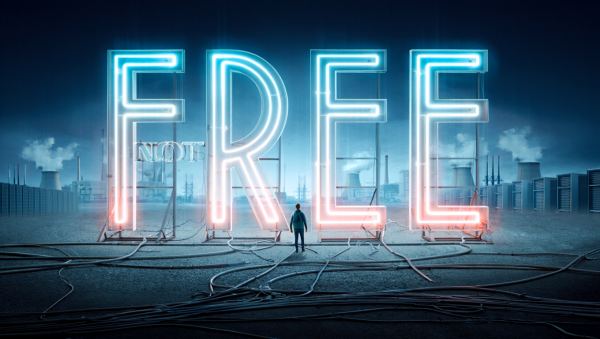
[DigitalToday reporter Jinju Hong] A sceptical analysis has emerged over expectations that advances in artificial intelligence (AI) will bring an era of abundance that makes everything free. The key, it said, is not that costs disappear but who controls the infrastructure and energy that make it possible.
On March 19 local time, blockchain outlet Cointelegraph reported that Merav Ozair (머라브 오자이어) said optimism that AI will end poverty and provide universal wealth is "far from reality". Elon Musk, Peter Diamandis and Demis Hassabis predict AI will bring "radical abundance", but the real economic structure is far more complex, it said.
AI combined with robots, 3D printing and automated logistics systems could sharply lower production costs. In theory, not only digital content but also the marginal cost of physical products could fall to near zero. But that is possible only on the premise that energy costs become extremely low. In an environment where energy costs remain high, full free access is difficult, the analysis said.
Current AI infrastructure relies on data centres that require massive electricity, so-called AI factories. Nvidia, Amazon Web Services (AWS) and SpaceX, among a small number of companies, are leading that infrastructure, and asset concentration is likely to deepen as productivity and profits grow.
Nuclear fusion is mentioned as an alternative to lower energy costs, but commercialisation is expected to take decades. Nuclear fission is already in use but carries waste and safety issues. As a result, expanding infrastructure based on renewables such as solar and wind is presented as a realistic solution. China is also building an AI-energy combined ecosystem through large-scale investment in renewable energy.
Some also present long-term scenarios such as moon-based solar power generation or building space infrastructure. But the assessment is that they are unlikely to become reality in the short term because of massive upfront costs and technical challenges.
Ozair said the conclusion is that complete free access will not be easy even in the AI era. AI can lower production costs, but the scope and conditions of what becomes free will inevitably be determined by who owns the infrastructure and energy that make it possible.
Experts point out that "free services may be possible, but in return data control or restrictions on choice may follow". That is, the abundance AI creates is not a matter of technology but a matter of power and structure.
 Jinju Hong
hongjj@d-today.co.kr
Jinju Hong
hongjj@d-today.co.kr