
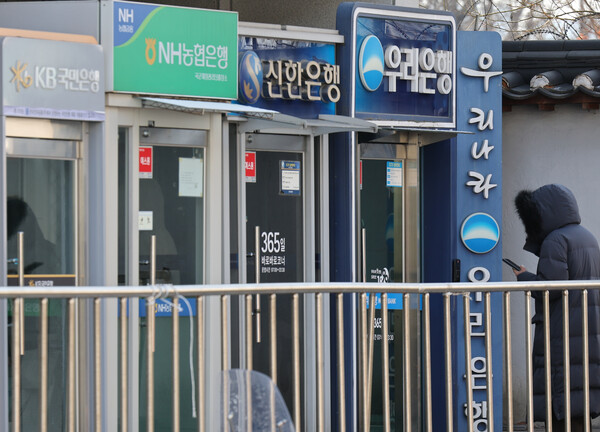
As of end-January, the delinquency rate on domestic banks’ loans in South Korea rose again from end-2025.
The Financial Supervisory Service said on Thursday that as of end-January, the delinquency rate on domestic banks’ won-denominated loans, based on overdue principal and interest of at least 1 month, was 0.56 percent. That was up 0.06 percentage point from 0.50 percent at end-2025.
The rate climbed to 0.60 percent in November, then fell to 0.50 percent at year-end, before rebounding a month later.
This trend is analysed as reflecting a rise in new delinquencies while the cleanup of delinquent claims fell sharply. Newly delinquent claims declined from 2.6 trillion won in November to 2.4 trillion won at year-end, then expanded again to 2.8 trillion won in January.
By contrast, the amount of delinquent claims cleaned up surged from 1.9 trillion won to 5.1 trillion won over the same period, then fell sharply to around 1.3 trillion won in January.
Typically, delinquent claims are cleaned up in a concentration at quarter-ends, lowering delinquency rates, and a seasonal pattern appears in which they rise again the following month.
The new delinquency rate in January was 0.11 percent, up 0.01 percentage point from 0.10 percent the previous month.
By loan type, delinquency rates rose for both household and corporate loans. The delinquency rate on household loans was 0.42 percent, up 0.04 percentage point from the previous month.
Within that, the delinquency rate on mortgage loans rose 0.02 percentage point to 0.29 percent. Household loans excluding mortgages, including credit loans, rose 0.09 percentage point to 0.84 percent.
The delinquency rate on corporate loans was 0.67 percent, up 0.08 percentage point from 0.59 percent at end-2025. Loans to large companies rose 0.01 percentage point to 0.13 percent, while loans to small and medium-sized enterprises rose 0.10 percentage point to 0.82 percent.
The Financial Supervisory Service said it would continue to check asset soundness, focusing on vulnerable industries, given growing uncertainty in domestic and external economic conditions such as the situation in the Middle East. It said it plans to guide the banking sector’s soundness management by expanding the sale of non-performing loans and strengthening loss-absorption capacity.
 Ji-young Lee
ljy@d-today.co.kr
Ji-young Lee
ljy@d-today.co.kr