
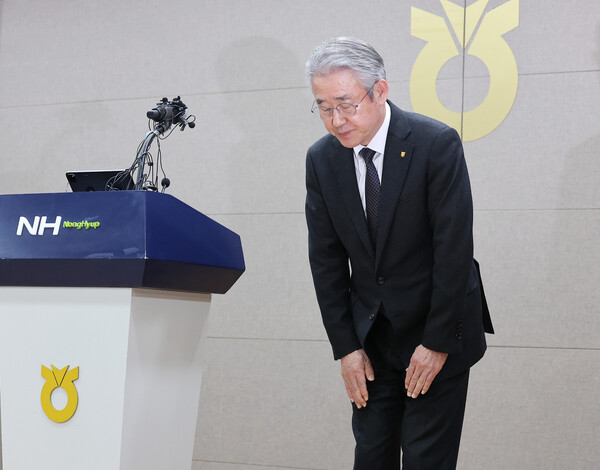
The government and the ruling party have begun efforts to improve Nonghyup's so-called imperial power structure. They are pushing to revise the Nonghyup Act so duties can be suspended if a first trial results in a guilty verdict on charges such as embezzlement, breach of trust and bribery. The move is also adding momentum to calls for Nonghyup chairman Kang Ho-dong (강호동) to step down.
The government and the ruling party announced what they called a first-stage plan for Nonghyup reform and decided to pursue revisions to the Nonghyup Act to spell out the grounds for suspending duties, the industry said on Thursday. They also plan to codify a ban on the chairman concurrently holding posts at affiliates and to restrict involvement in personnel and management decisions.
While there were already rules on suspending duties, there were no cases where they were applied, and the revision is seen as a step to effectively ensure the system works. The planned creation of an independent audit body under the agriculture ministry, called the Nonghyup Audit Committee, is in the same vein. The plan also includes expanding the scope of audits beyond the central federation and cooperatives to the business holding company and subsidiaries, and oversight across the board is expected to be strengthened.
Allegations surrounding Kang have spread beyond a simple dispute to a level that shakes trust in the organisation. Following the results of a government special audit, circumstances emerged suggesting 490 million won of project funds from the Nonghyup Foundation were used to provide election-related gifts in return. Kang was also included among those to be referred for investigation over allegations he received a gold key weighing 10 don, worth about 5.8 million won at the time, purportedly to mark the first anniversary of his inauguration.
The government has referred the matter to police on suspicions including embezzlement and violations of the anti-graft law. If it leads to an indictment and a first-trial ruling, the possibility of a suspension of duties cannot be ruled out, in conjunction with the legal revisions.
Kang, however, has brushed aside calls for him to resign, effectively appearing to dig in. He said some parts of the audit results differed from the facts and stated he did not agree with demands that he step down. While apologising, he has maintained a stance that he will not accept calls over his future, and backlash from politicians and farmer groups is growing.
Jeon Jong-deok (전종덕), a lawmaker from the Jinbo Party, pressed him by saying, "Kang is a target of reform, not the subject of reform. He should step down and be investigated," but Kang replied, "I cannot agree." Kang added, "If there is a legal problem, I will take responsibility," and said, "There are parts of the audit results I can accept, and parts that are not true."
In the field, a sense of crisis over a collapse in trust is already spreading. Farmer groups in North Jeolla and South Gyeongsang provinces held a series of news conferences and demanded an immediate resignation and sweeping reform. They say the incident is not a personal deviation but the result of a privileged structure and opaque operating practices accumulated under successive central federation systems. Criticism from within the farming community that Nonghyup has been run as a power-centred structure rather than an organisation for farmers highlights the seriousness of the situation.
The fallout is also spreading to financial affiliates. NH Investment & Securities excluded an agenda item to appoint a chief executive officer at its board meeting and delayed procedures to select the next CEO. It plans to prioritise discussions on revamping the governance structure. As Nonghyup Financial Group is under a 100 percent ownership structure controlled by the central federation, some interpret the move as aligning with the policy direction to block the federation's influence over personnel decisions. A broader review of what is called a close-aide appointment structure formed under Kang has also been raised.
Appointments at Nongmin Newspaper are also at the centre of controversy. As the government and ruling party push to ban the central federation chairman from holding concurrent posts, Nongmin Newspaper plans to prepare new procedures to appoint a CEO through amendments to its bylaws. But debate over fairness in appointments has flared again after Yoo Chan-hyung (유찬형), a former vice chairman of the Nonghyup central federation classified as a close aide to Kang, was confirmed as the final candidate through the executive candidate recommendation committee. There is also a view that if transparency in the selection process is not secured, it could undermine trust in overall reform.
Discussions on internal reform at Nonghyup are also under way. Nonghyup's central federation is discussing steps including improving the election system, strengthening fairness in personnel decisions and reinforcing internal controls through its own reform committee, and plans to soon finalise an execution roadmap. Concerns have been raised, however, that it could end up as self-reform if key tasks such as reducing the chairman's authority and blocking intervention in affiliate appointments are not sufficiently reflected.
Ultimately, the essence of the situation lies in whether Nonghyup can resolve structural problems beyond whether there was personal wrongdoing. With repeated exposure of issues such as a concentration of authority in the chairman, opaque budget execution, influence over affiliate appointments and failures of internal controls, partial institutional supplements alone have clear limits. There is also an assessment that unless substantive decentralisation of authority and stronger oversight are pursued alongside the question of Kang's future, Nonghyup reform is likely to again remain formal.
A financial industry official said, "In the current situation, can reform be possible only through institutional improvement without personnel changes?" The official added, "There is a strong concern that as long as the current management structure is maintained, reform could remain formal."
 Lee Ji-young
ljy@d-today.co.kr
Lee Ji-young
ljy@d-today.co.kr