
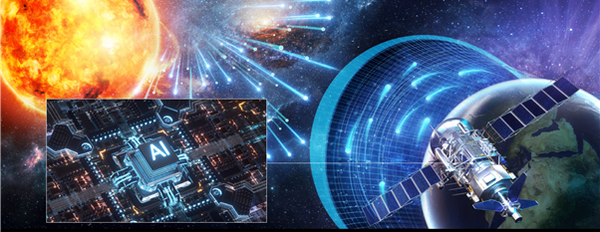
South Korea's Ministry of Science and ICT and the Korea Atomic Energy Research Institute said on Wednesday that a joint research team involving the Korea Atomic Energy Research Institute's Advanced Radiation Research Institute, Chungbuk National University and Belgium's IMEC has, for the first time, verified next-generation artificial intelligence (AI) semiconductor technology that operates stably even in a space-radiation environment.
As space exploration technology rapidly advances, securing radiation-hardened characteristics so semiconductor devices can withstand the harsh radiation environment of space has emerged as a challenge for chips that will process AI and big data analysis. The joint team produced an indium-gallium-zinc oxide (IGZO)-based synaptic transistor, a next-generation semiconductor material, and verified the feasibility of using AI semiconductors in space environments.
IGZO is thin and transparent and has strong electrical properties, making it a key material for next-generation displays and logic devices. A synaptic transistor mimics synapses in the human brain to carry out high-efficiency AI computation at low power.
The team used KAERI's proton accelerator to irradiate the device with a 33 MeV-class high-energy proton beam. The radiation dose was set to a level equivalent to more than 20 years of exposure to space radiation in low Earth orbit. That exceeds the typical 5 to 15-year lifespan of low Earth orbit satellites.
After re-evaluating device characteristics, the team observed performance degradation, including a partial decline in driving current. It confirmed, however, that switching operation, which is core to semiconductors, and synaptic plasticity, a key characteristic of neuromorphic devices, were stably maintained.
In particular, a neuromorphic computing simulation conducted under radiation exposure (MNIST handwritten digit recognition) recorded a pattern-recognition accuracy of 92.61 percent. The team also implemented a reservoir computing system suitable for processing time-series information and demonstrated 4-bit computing capability, presenting practical feasibility in a space-radiation environment.
The research was carried out through a ministry-supported project. The team led by Byung-jin Cho (조병진), a professor at Chungbuk National University, handled device fabrication and characterization, while Chang-gu Kang (강창구), a principal researcher at KAERI, took charge of proton irradiation design and analysis. Tae-jin Yoo (유태진), a researcher at Belgium's IMEC, supported interpretation of the results. The findings were published in the March issue of the international journal 'Journal of Semiconductor Process and Materials Science.'
Oh Dae-hyun (오대현), director general for future strategic technology policy at the ministry, said, "This achievement is a case showing the possibility that AI systems can operate normally even in extreme environments such as space," and added, "We will continue to provide support so that South Korea can secure core source technologies in the field of space and aerospace AI semiconductors and become self-reliant."
 Jin-ho Lee
jhlee26@d-today.co.kr
Jin-ho Lee
jhlee26@d-today.co.kr