
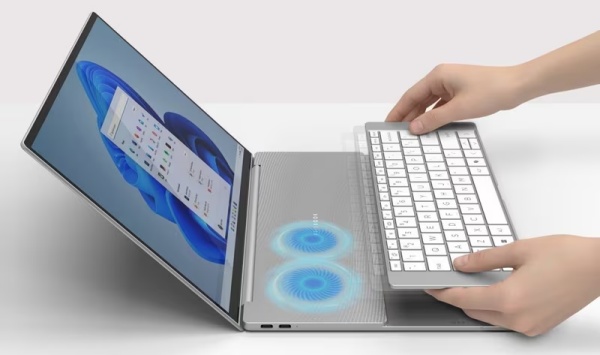
[DigitalToday reporter Jinju Hong (홍진주)] Taiwan electronics manufacturing services (EMS) company Inventec unveiled an experimental laptop, VeilBook, with an unusual structure. It features a new approach that improves cooling performance by physically moving the keyboard.
Tech outlet TechRadar reported on March 18 that VeilBook is a concept product with a 14-inch display and an ultrathin chassis less than 10 mm thick. As competition heats up in ultra-slim laptops, it is drawing attention as a case that redesigns the internal structure rather than simply reducing thickness.
Its biggest feature is a "sliding keyboard". In its default state, the keyboard sits over the touchpad and palm rest area, but users can push the keyboard back to expose the touchpad when touch input is needed. This simple mechanical structure changes not only the user interface but also the internal heat-management design at the same time.
The design is closely tied to the system's cooling structure. In typical laptops, fans and ventilation structures are placed under the keyboard, often limiting airflow. With VeilBook, moving the keyboard back fully opens the vents, allowing more air to pass through the chassis. The goal is to effectively reduce heat generated during high-load tasks and lower the possibility of performance degradation, or throttling.
There are drawbacks. For optimal cooling, the touchpad must be covered under the keyboard, so users need to rely on keyboard shortcuts or an external mouse. Critics also say it may feel unfamiliar to general users because it differs from the intuitive way conventional laptops are used.
VeilBook has already won an iF Design Award, earning recognition for its innovation. Still, the chances of commercialisation are low. Inventec is an ODM company that designs and produces hardware for global companies rather than selling products under its own brand, and this project also has a strong experimental character aimed at suggesting a technological direction.
Inventec previously won a design award for a fanless laptop that removed the fan, but this time it designed a more complex mechanical structure to maximise fan efficiency. That shows various attempts are continuing to solve heat problems in ultra-slim laptops.
The industry is assessing VeilBook not as a product that will be launched immediately, but as a case exploring new possibilities in laptop design. It is also being analysed as another experiment in how to address the conflicting tasks of an ultrathin design and heat management.
 Jinju Hong
hongjj@d-today.co.kr
Jinju Hong
hongjj@d-today.co.kr