
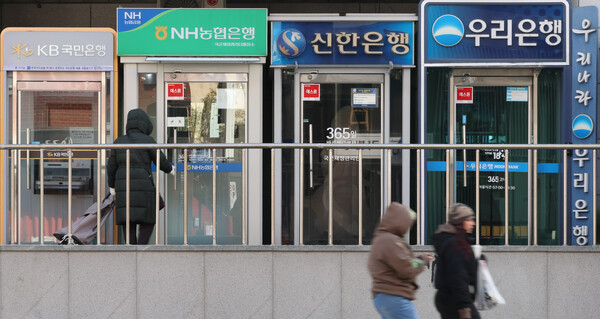
South Korea's four largest financial groups, including KB, Shinhan, Hana and Woori, are accelerating a shift from interest income to investment in innovative industries under what they call “productive finance”. They are detailing supply plans and adjusting dedicated organisations and key performance indicators, moving beyond declarations and entering competition over execution speed and results.
The four groups plan to supply a total of 400 trillion won of productive finance over the next five years, the financial sector said on Thursday. The aim is to expand financial support for advanced industries such as AI, semiconductors, secondary batteries and renewable energy to build growth engines for the economy amid intensifying global competition for technological leadership. A key element is a structural shift away from a stable profit model centred on mortgage loans toward corporate and investment finance.
By size, KB Financial Group and Shinhan Financial Group each plan 110 trillion won, followed by Hana Financial Group with 100 trillion won and Woori Financial Group with 80 trillion won.
KB Financial plans to supply 110 trillion won by 2030. Of that, 93 trillion won of productive finance consists of 25 trillion won in investment finance and 68 trillion won in strategic industry loans.
It recently completed arranging senior and subordinated loans worth 2.89 trillion won for the Sinan Ui offshore wind power project in South Jeolla Province, highlighting its presence in renewable energy infrastructure. KB Financial is estimated to disburse 17.7 trillion won this year.
Shinhan Financial has also set a plan to supply 110 trillion won by 2030. It decided to disburse 20 trillion won this year alone. The plan is structured as 2 trillion won for the National Growth Fund, 2 trillion won for the group’s own investments, 13 trillion won in credit support and 3 trillion won in inclusive finance. It combines investment and policy funds rather than relying solely on lending.
Hana Financial finalised this year’s supply amount at 17.8 trillion won, up 1.6 trillion won from the previous plan, as part of its 100 trillion won programme. It broke the total down into 2.5 trillion won for AI and advanced infrastructure, 2.5 trillion won for venture capital and balanced regional development, 10 trillion won for core advanced industries and 2.8 trillion won to support export supply chains. It adopted a selection-and-concentration strategy by specifying targets by industry.
Woori Financial was the first last year to declare an 80 trillion won productive finance programme. It said it plans to deploy 3.4 trillion won first this year, consisting of 2 trillion won for the National Growth Fund and 1.4 trillion won for the group’s own investments.
It also presented a plan to create a 200 billion won National Growth Matching Fund, the first in the financial sector, and expand it to 10 trillion won over the next five years. The total amount Woori Financial will deploy this year is 16.1 trillion won.
Execution battle... KPIs and organisations revamped
The key to productive finance is expected to be execution rather than planning. To that end, the four groups have reorganised their structures and evaluation systems in tandem.
KB Financial created a CIB Market division overseeing the group’s corporate finance and capital markets, and KB Kookmin Bank launched a Growth Finance Promotion headquarters. It plans to select priority industries and link support with non-financial consulting to systematise corporate assistance.
Shinhan Financial finalised an execution roadmap centred on its group productive finance promotion committee. It reflected implementation targets in the group’s strategic tasks and KPIs and linked them to evaluations of the holding company and major subsidiary executives to clarify accountability for results.
Hana Financial launched a group productive finance council and checks implementation progress each month. It is building a company-wide management system by pursuing KPI revisions, risk management upgrades and a redesign of its compensation system in parallel. Hana Bank also reorganised its Productive Investment division and Inclusive Finance Products department and created a dedicated review team for advanced strategic industries.
Woori Financial has also established dedicated investment and lending organisations within Woori Bank’s IB group and corporate group. It is moving to execution by placing IB functions at the forefront, using its Productive Finance Investment department as a control tower.
As “productive finance” moves beyond declarations into an execution phase, market attention is shifting to the actual pace of disbursement and results at each financial holding company. With the issue directly tied to management KPIs, attention is focusing further on performance.
A financial sector official said, “Beyond responding to government policy, corporate and investment finance competitiveness is now a phase directly linked to the survival of financial groups.” The official added, “We are concentrating company-wide capabilities to execute substantive productive finance.”
 Ji-young Lee
ljy@d-today.co.kr
Ji-young Lee
ljy@d-today.co.kr