
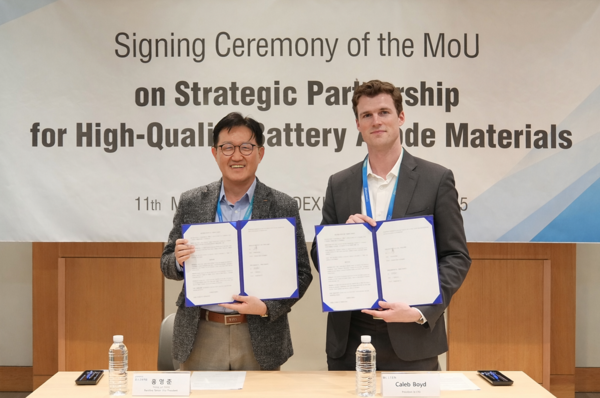
POSCO Future M will secure raw materials for natural graphite anode materials without relying on mining. POSCO Future M said on March 19 it signed a memorandum of understanding with U.S. company Molten to jointly develop methane gas-based feedstock for natural graphite anode materials. Attending the signing ceremony were Hong Young-joon (홍영준), head of POSCO Future M's Technology Research Institute, and Molten executives including Chief Executive Kevin Bush (Kevin Bush) and Chief Technology Officer Caleb Boyd (Caleb Boyd), along with employees from both companies.
POSCO Future M will strengthen its anode material supply chain through the agreement. Molten is the only company in the world that can produce graphite by pyrolyzing methane gas. It is headquartered in California. Under the plan, Molten will produce graphite through methane pyrolysis, and POSCO Future M will process it into spherical graphite through its subsidiary Futuregraph and then produce natural graphite anode materials at its Sejong plant.
Graphite produced from methane gas has lower metal impurity content than mined graphite. This can reduce the refining process, making it possible to cut production costs for natural graphite anode materials, the company said. It is also reviewing options to use hydrogen generated along with graphite during methane pyrolysis for power generation or to supply it for POSCO's hydrogen-based direct reduced ironmaking.
POSCO Future M is promoting internalisation of its anode material raw-material supply chain at the POSCO Group level. For natural graphite anode materials, it plans to build a supply chain that processes graphite ore secured in Africa and elsewhere into spherical graphite at Futuregraph. For artificial graphite anode materials, it is using coal-based and petroleum-based coke made from coal tar from POSCO's steelmaking process as raw material.
Hong said the companies have relied on graphite mined from mines, but will secure core raw materials in a new way by combining their raw-material and material technologies. He said he expects this to strengthen differentiated competitiveness in the global market by diversifying the raw-material supply chain and reducing costs.
 Daegeon Seok
d2dg@d-today.co.kr
Daegeon Seok
d2dg@d-today.co.kr