
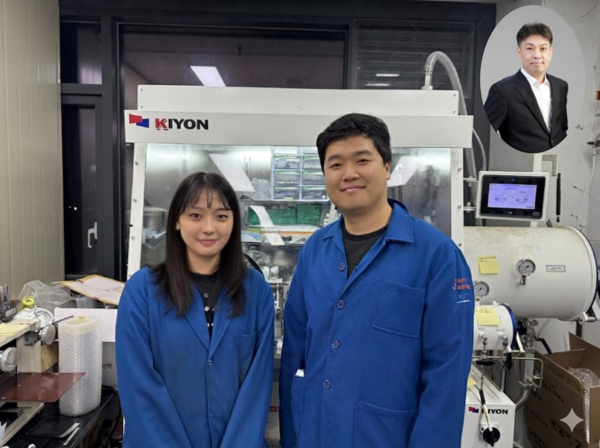
A KAIST research team said on Saturday it has addressed interfacial instability in anode-free lithium batteries using an ultra-thin polymer layer. The team led by Professors Jinwoo Lee and Sunggap Lim of the Department of Biological and Chemical Engineering introduced a 15-nanometre artificial polymer layer on the electrode surface. It said the approach secures both longer life and stability without changing the electrolyte composition.
Anode-free metal batteries use only a copper current collector on the anode, instead of graphite or lithium metal. As a result, they have 30 to 50 percent higher energy density than conventional lithium-ion batteries. They also offer lower manufacturing costs and simpler processes.
But during the initial charging process, lithium accumulates directly on the copper surface and the electrolyte is rapidly consumed. An unstable solid electrolyte interphase (SEI) forms, sharply reducing battery life.
Instead of changing electrolyte composition, the team chose a strategy that designs the electrode surface itself. Using an initiator-based chemical vapor deposition (iCVD) process, it formed a uniform ultra-thin polymer layer on the copper current collector. It explained that the layer regulates interaction with the electrolyte, precisely controlling lithium-ion transport and electrolyte decomposition pathways.
The polymer layer developed in the study does not mix well with the electrolyte solvent, inducing decomposition of salt components instead of the solvent. In existing batteries, electrolyte solvents decompose and form a soft, unstable organic protective layer. Lithium does not deposit evenly and needle-like dendrites readily grow. The new approach formed a hard, stable inorganic SEI. Electrolyte consumption and excessive growth of the protective layer were both suppressed.
The researchers identified the mechanism using operando Raman analysis and molecular dynamics (MD) simulations. They confirmed that an anion-rich environment forms on the electrode surface while the battery operates, leading to the creation of a stable inorganic SEI.
The technology adds only a thin layer to the electrode surface without changing electrolyte composition, offering high compatibility with existing processes and a low cost burden. It said the iCVD process enables large-area continuous production in a roll-to-roll 방식, making it suitable for industrial mass production.
Professor Jinwoo Lee said the study is significant because it presents a design principle showing that electrolyte reactions and interfacial stability can be controlled through electrode surface design. He said it is a technology that can speed up commercialisation of anode-free lithium metal batteries in next-generation high-energy battery markets such as electric vehicles and energy storage systems (ESS).
PhD student Juhyun Lee and postdoctoral researcher Jinwook Kim of KAIST's Department of Biological and Chemical Engineering participated as co-first authors. The results were published in the energy journal Joule on Dec. 10, 2025.
 Daegeon Seok
d2dg@d-today.co.kr
Daegeon Seok
d2dg@d-today.co.kr