
[DigitalToday reporter Seulgi Son] "For architecture, engineering and construction (AEC) companies to introduce AI, the shift to the cloud ultimately has to come first."
Dropbox, a global cloud collaboration solutions company, is speeding up its push into AEC, its next key market. With AEC seen as a traditional industry with strong inertia to keep on-premises servers, the company aims to begin aggressive sales by leveraging 20 years of technology in synchronisation, security and speed.
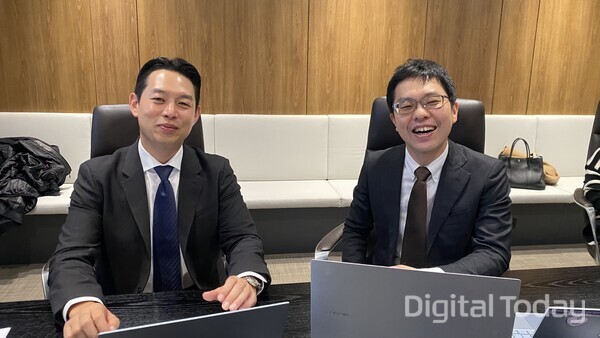
In an interview with DigitalToday on March 18, Shin Jae-yong (신재용), head of Dropbox business for South Korea and Vietnam, said moving data stored on-premises to the cloud is a prerequisite for moving into an AI environment. He said demand for cloud-based data management is growing as a surge in project data, the constant threat of ransomware and the spread of distributed work environments converge.
Dropbox believes it has an advantage in securing an early lead due to AEC customer characteristics that distinguish the sector from others. Yuki Kami (유키 카미), head of technical solutions for Dropbox Asia-Pacific and Japan (APJ), said the sector handles large files such as design drawings, video and 3D scan data, and that sites operate continuously regardless of time and location, creating a need for real-time data organisation. Shin said design, cost and quality-and-safety information is the business foundation itself in the industry. He added that because data problems can directly lead to project stoppages, demand is high for secure storage and immediate recovery, and Dropbox is being recognised for user convenience, speed and security.
Technically, it said block-level storage is a differentiating point. Files are split and stored in 4 megabyte units, so when a 100 megabyte file is edited, only the changed blocks need to be retransmitted. That reduces transmission burdens and speeds up collaboration. Shin said other cloud providers often resynchronise the entire file, while Dropbox processes only the changed parts. He described it as synchronisation technology built over 20 years.
The approach is also effective at construction sites with limited bandwidth. In unstable network environments, files can be exchanged via direct device-to-device (P2P) connections without going through a server, and video files can be checked immediately through streaming before a full download. Kami said the high resolution of the data-splitting approach allows file sharing and stability to be ensured even in extreme environments.
On security, it highlighted its long file restoration period. Even files deleted in a user environment are retained for 1 year under the advanced plan, and up to 10 years with the extended version history (EVH) option. Kami said most rivals are at about 90 to 100 days, and cases have been reported in which ransomware develops and then activates after waiting out that period. He said deleted-file retention and version history do not count against purchased storage capacity.
It also sees high growth potential in South Korea's AEC market. Shin said South Korea has been slower to adopt the cloud than Japan and Australia, and that industry resistance to cloud use and on-premises inertia remain obstacles, but that inquiries are increasing as a government-led push for AI transformation strongly takes hold and companies recognise the need to shift. Kami said drivers of digitalisation differ by region. He said in East Asia, digital transformation discussions are beginning as the challenge of how to pass on built assets created decades ago to the next generation comes to the fore.
It also expects synergies with its AI-based search tool, Dash for Business. The tool enables integrated natural-language searches not only across Dropbox products but also through external tools such as Google Workspace and Microsoft 365. Shin said searches can be made with prompts such as "find the site photos taken outdoors last year" or "find the drone video file." He added that productivity rises as the time spent figuring out which folder and which project to enter is reduced.
Shin said Dash is also receiving strong responses in actual industrial settings. Citing the example of Southbase Construction, a New Zealand builder, he said it previously took 4 to 5 hours to compile files spread across Dropbox, Microsoft OneDrive and Google Cloud to write safety and quality management reports at the company, where 85 percent of staff are distributed across sites. He said after adopting Dash, that was reduced to 30 minutes to 1 hour, and that client companies receiving the reports gave feedback that the quality was higher than what people wrote.
In South Korea, mid-sized architecture firm Sunjin Engineering is cited as a successful adoption case. Shin said before implementation, data was scattered across multiple storage environments and there was no file visibility at all. He said after adopting Dropbox and integrating into a single central environment, access to large CAD and BIM files became possible on mobile devices and tablets, and it also became possible to transfer materials from departing employees and control unauthorised removal of design drawings.
 Seulgi Son
sageson@d-today.co.kr
Seulgi Son
sageson@d-today.co.kr