
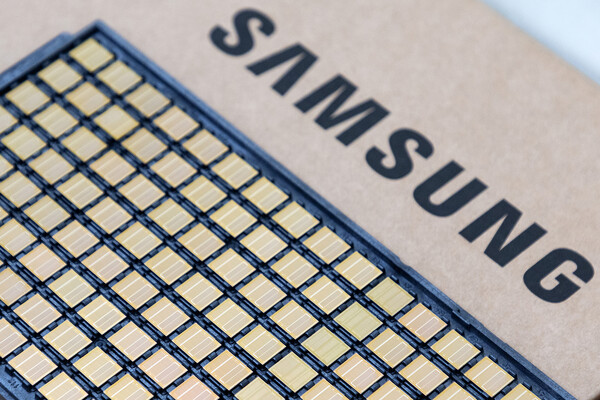
Samsung Electronics on Tuesday formalised its 2026 business strategy at a shareholders meeting around three pillars: semiconductors (DS), devices (DX) and robots. It aims to speed up a shift to an AI-centred business structure after spending 37.7 trillion won on research and development and 52 trillion won on facility investment last year. It also underscored technology it showcased by unveiling a next-generation HBM4E physical chip for the first time at Nvidia GTC in the United States.
At the company’s 57th annual general meeting held at Suwon Convention Center in Gyeonggi province, DS division head Jun Young-hyun (전영현), a vice chairman, presented a "comprehensive AI semiconductor solutions company" as the core direction. He said its IDM (integrated device manufacturer) structure, spanning memory, foundry, logic design and packaging, is a differentiating point compared with competitors.
Jun said quality, mass production competitiveness and profitability have recovered to some extent, but strengthening differentiated fundamental technology competitiveness will be pursued as the top priority. He also added a cautious stance, saying it will seize opportunities from rising AI demand while preparing for various scenarios.
The detailed strategy has three tracks. In memory, it will shift its profit structure toward high value-added products for AI and servers such as HBM4, and also strengthen cost competitiveness by improving investment efficiency and productivity. In foundry, it will focus on securing leadership in 2-nanometre technology based on its GAA (Gate-All-Around) process, and strengthen advanced-process business based on AI demand in areas such as data centres and robotics.
System LSI will expand cooperation with strategic customers by emphasising customised SoCs (systems on chip) and high-pixel image sensors. Internally, it will use AI technology to advance the entire production area from design to manufacturing and quality, and broaden the foundation for next-generation growth with integrated solutions that cover advanced packaging.
It backed up the strategy in tangible form at Nvidia GTC 2026 taking place in the United States this week. Samsung Electronics unveiled for the first time an HBM4E chip based on its 1c DRAM process and a base die built on its foundry 4-nanometre process. It supports 16 Gbps per pin and 4.0 TB/s bandwidth. It also showcased HCB (Hybrid Copper Bonding) packaging that lowers thermal resistance by more than 20 percent. It said it is the only company capable of supplying the full range from HBM4 for Nvidia’s Vera Rubin platform to SOCAMM2 and the PM1763 storage product.
Investment is also expected to increase. Last year, Samsung Electronics invested 37.7548 trillion won in R&D, its largest amount ever. The sum was up 7.8 percent from a year earlier, and DS division facility investment alone reached 47.4764 trillion won. A Samsung Electronics official said it will cement its position as a comprehensive AI semiconductor solutions company as the world’s only semiconductor company capable of one-stop solutions.
◆DX declares 800 million AI devices and robots in 'deployment'
DX division head Roh Tae-moon (노태문), a president, put "agentic AI" at the forefront. The direction is to innovate all products and services on an AI basis and spread AX (AI transformation) across all work. For smartphones, it aims to lead an era of agentic AI phones by combining hardware competitiveness with Galaxy AI, and will double the number of Galaxy AI-equipped devices to 800 million next year from 400 million this year.
For TVs, it will convert its entire lineup to AI TVs and grow a service revenue model through differentiating Samsung TV Plus content and its advertising platform. In home appliances, it will pursue a 'home companion' strategy with AI personalised services, and will also fully target the AI data centre cooling and air-conditioning market based on its acquisition of FlaktGroup. Harman will strengthen its position as a leading company in the automotive electronics field with an AI intelligent cockpit and ADAS capabilities.
The success of the Galaxy S26 series is based on the agentic AI concept. The series set a record for the S lineup with 1.35 million units in the first 7 days of pre-orders despite a downturn in the global smartphone market. With the Ultra model accounting for 70 percent and the AI Subscription Club sign-up rate surpassing 30 percent, its premium and service strategy is working in the market. The performance came as Counterpoint Research forecasts global smartphone shipments this year will fall 12.4 percent from a year earlier to the lowest level in 13 years, making it more meaningful.
Robots will move from concept to deployment. The goal is to draw on company-wide capabilities to raise core competitiveness such as robot AI and hand technology to the world’s top level. It will first deploy high-precision manufacturing humanoids into its own production lines to accumulate data, and develop them into highly intelligent multipurpose humanoids. In medtech, it will pursue customised healthcare linking AI precision medicine and Samsung Health. Samsung Electronics plans to focus company-wide capabilities on future technology fields such as AI, 6G and robotics.
 Suk Dae-geon
d2dg@d-today.co.kr
Suk Dae-geon
d2dg@d-today.co.kr