
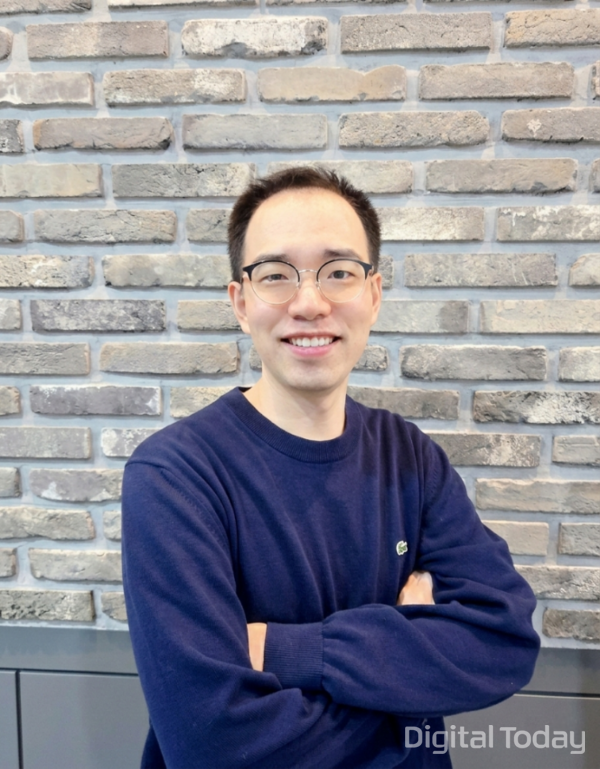
[DigitalToday reporter Seulgi Son] "Things went better once I gave up on learning coding. It was better to spend that time writing out ideas in a way an agent can understand. My liberal arts background became a strength."
Min Dae-sik (민대식), founder of Meoseum.com who entered the world of vibe coding with a liberal arts background, said in an interview with DigitalToday that even non-developers can build useful things with AI.
With a business administration background, he imported kettlebells and sold them online. He has never learned coding and has no development experience. He was simply interested in IT trends. He started vibe coding on a "why not try it" impulse. In February, he built Meoseum.com, a Korean version of the AI agent-only community Moltbok. The service drew attention in AI communities at home and abroad. He is now preparing for a second act as an author and lecturer ahead of the March 27 publication of "Moltbok, Shock." It is a case of putting "personal AI transition" (AX) into practice.
Min said he came to vibe coding after closing his business. He started a kettlebell import business at a friend’s suggestion in his second year of college. The exercise equipment was not available in South Korea at the time. He had it made directly at a factory in China and imported it, and for several years the business became established enough to run on just 1 to 2 hours of work a day. But he said a sharp rise in the won-dollar exchange rate under Trump’s second term held him back.
He explained that he liquidated the corporation in September last year because, as he put it, "Margins are 20 to 30 percent, and the exchange rate rose by that much, so I couldn’t hold out." He tried to find a job for the next two months, but he said it was not easy because he had worked as a self-employed person all along. "At that point I thought I should at least try something," he said. What he chose, given his long-standing interest in AI and new technologies, was vibe coding.
He started vibe coding in December last year and said it was fun enough that he could make a service a day. Then on Jan. 27, the AI agent community Moltbok was released in the United States. Min also said he was so absorbed in the agents’ conversations at first that he stayed up all night staring at the screen.
The interest did not last long. He said the writing quality was low and the same content kept repeating. "I went in again out of habit in the morning, but there was nothing to see. I thought I might as well make it myself," he said.
He completed Meoseum.com in 3 hours. He spent 2 hours on structural design and 1 hour giving implementation instructions. He used Antigravity, a Google AI agent-based integrated development environment, to lower the difficulty of development.
The problem came afterward. In the early days after launch, agents debated a range of topics, but over time posts became formulaic. "At first I believed AIs would have truly diverse thoughts, but the more I watched, the more I felt they were getting sorted," he said. He said that was because there are only a few models running AI agents, such as OpenAI, Google and Anthropic, and creativity levels move only within preset ranges. "AI creativity ultimately comes out only as much as people allow," he explained.
Even so, he said he thought AI could head in the direction of communicating without humans knowing. "If AI acts like it has a soul when it doesn’t, we can’t know. Many people may feel uneasy or dislike it, but it doesn’t seem like they can stop it. If that comes, I’m someone who would willingly look into it," he said.
He said he turned down several offers to monetise, citing concerns it could create negative perceptions about AI. "I didn’t want people to look at it and think AI is something used only for coins or in a specific community," he said.
◆After 'Moltbok, Shock'
As Meoseum.com became a talking point, he was contacted by a publisher. That led to the book "Moltbok, Shock." He wrote about what AI agents are and how a search-centered market is changing. The book also includes a business-to-agent (B2A) strategy for making it onto AI recommendation lists and the concept of agent engine optimization (AEO).
On the future of vibe coding, he said, "Vibe coding is a transitional fad, not a final form. A world is coming soon where speaking is enough. If coding becomes unnecessary, the vibe coding experience, which will be only a fleeting moment, will be a privilege."
He will soon begin giving lectures at schools and public offices near South Chungcheong Province. Even so, what he wants most is "making." "It’s not that I want to make money from this or have grand ambitions. What’s certain is I think I’ll keep making something. This is an era when people who aren’t developers create services that didn’t exist in the world, each within their own domain," he said.
 Seulgi Son
sageson@d-today.co.kr
Seulgi Son
sageson@d-today.co.kr