
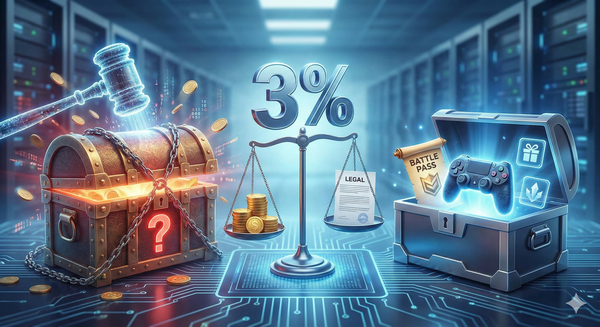
Randomized items, once the South Korean game industry's "golden goose", have now turned into "poison" that threatens survival. As the government and parliament bring out tough economic sanctions known as "financial treatment", they are fundamentally shaking up the revenue models that local game companies have relied on for more than a decade.
"Up to 1 billion won if caught" ... a 3 percent of revenue hammer instead of slap-on-the-wrist punishment
The industry is watching most closely as the regulatory paradigm shifts from "guidance" to real "punishment", the industry says. An amendment to the Game Industry Promotion Act, proposed on Dec. 23 by Democratic Party lawmaker Kim Sung-hoe, would impose a penalty equal to 3 percent of a game company's revenue or up to 1 billion won if probability information is falsely displayed or not disclosed.
Under current law, regulators first issue corrective orders, and only if companies fail to comply can violators face up to 2 years in prison or a fine of up to 20 million won. Critics in and outside the industry have long said penalties are far too light compared with the huge profits from manipulating probabilities, leaving little incentive to follow the law. Some game companies were recently caught violating probability disclosure rules but received administrative fines of only a few million won, sparking debate over effectiveness.
The amendment aims to block such "slap-on-the-wrist" punishment at the root. President Lee Jae-myung, during a Culture Ministry briefing on Dec. 16, pointed to the complexity of the current rules and stressed the need to directly target "profits", the underlying cause of violations. The idea is to remove incentives for illegal acts through so-called "financial treatment" that immediately claws back economic gains from probability manipulation. Even if the violation is a simple mistake, companies could face a financial hit worth 3 percent of revenue, sending a strong warning to the industry.
Ditching the "Lineage" playbook ... shifting to fixed-price products and consoles
As regulation sharpens, game companies are accelerating changes to their business models. The focus is to reduce reliance on randomized items and expand non-randomized products. NCSoft plans to exclude randomized items entirely from the business model of its new title "Aion2" and introduce fixed-price products such as memberships and battle passes, which are popular with users. It aims to move away from the probability-based model often associated with "Lineage-like" games.
Major game companies are also turning to PC and console package games in the same vein. Nexon's "The First Berserker: Khazan", Neowiz's "Lies of P" and Shift Up's "Stellar Blade" are driving portfolio diversification by showing they can perform in global markets without randomized items.
The shift also aligns with global regulatory moves. The U.S. Federal Trade Commission is showing signs of moving to sanction randomized items as deceptive conduct, and platform operators such as Google and Apple are also trending toward mandatory disclosure of probabilities. Expanding "battle passes" that reward users for completing tasks over a set period, or monthly subscription products, is a practical survival strategy to avoid regulatory risk and secure stable revenue.
"Legal 대응 힘든데" ... practical fears for smaller game companies and publishers
The industry says it agrees with the intent of the regulation but is voicing practical difficulties. The biggest issue is controversy over "double regulation". With the Fair Trade Commission already sanctioning deceptive conduct involving randomized items under the e-commerce law, companies fear adding the game industry law amendment could lead to excessive overlapping punishment.
Smaller publishing companies with limited capacity for legal 대응 are expected to be hit hard. Unlike large companies, smaller game firms often rely heavily on a single title, and a single sanction that takes 3 percent of revenue could determine whether they survive. There is also criticism that it is realistically impossible for publishers, rather than developers, to verify a developer's code errors or missed updates one by one, and that this goes beyond the scope of contracts.
An industry official said, "Like the saying about burning down the whole house to catch a bedbug, excessive regulation could end up breaking the industry's backbone," adding, "Many small operators do not even earn a 3 percent operating margin, so a revenue-based penalty is essentially a harsh punishment no different from a death sentence."
There is also a need to resolve the ambiguity over whether the "revenue" used to calculate penalties refers to the revenue of the specific game or the entire corporation, as well as reverse discrimination issues involving overseas game companies without local entities.
Tougher regulation of randomized items is expected to cause significant pain for the industry in the short term. But there are also signs it is being seen as an opportunity for structural improvement rather than a simple crisis.
Another industry official said, "This bill reflects consumers' higher expectations," adding that game companies will have no choice but to speed up efforts to establish new revenue models rather than repeating old practices.
That aligns with Kim's remarks that, "The randomized item problem is conduct that undermines market order based on users' trust," as he stressed sustainable growth. Ultimately, the competitiveness of Korean games in a "post-randomized item" era is expected to be decided not by how quickly companies evade regulation, but by their ability to design new business models that meet global standards.
 Ho-jung Lee
lhj@d-today.co.kr
Ho-jung Lee
lhj@d-today.co.kr