
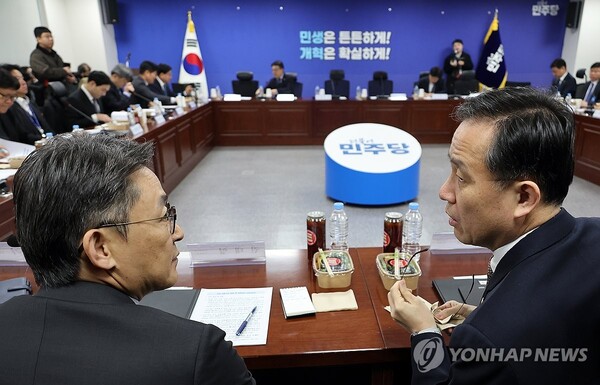
South Korea's Democratic Party and the government on March 16 decided to pursue a plan to release strategic oil stocks in phases over the next three months after global oil prices surged on the fallout from the Middle East war.
The government plans to draw up this year’s first supplementary budget to respond to the impact on livelihoods and energy from the Middle East situation and submit it to parliament by the end of March.
The Democratic Party’s task force on economic responses to the Middle East situation held a meeting at the National Assembly on Monday morning with government officials including those from the Ministry of Economy and Finance and the Financial Services Commission. Lawmaker Ahn Do-geol (안도걸), the task force secretary, told a briefing that it made the decision.
The task force discussed stabilising energy supply and demand, stabilising prices including oil prices, supporting affected small and medium-sized firms and self-employed business owners, stabilising foreign exchange and financial markets, and preparing the supplementary budget.
According to the briefing, the party and the government plan to release 22.46 million barrels of crude oil over the next three months, an agreed stockpile level under the International Energy Agency (IEA).
The Ministry of Trade, Industry and Energy will raise the current industrial crisis management level to "caution" from "attention" this week and announce details of the stockpile release plan.
Current crude oil stocks stand at 208 days of supply, while liquefied natural gas (LNG) stocks are at 9 days. Ahn said LNG supplies usable through the end of December have been secured.
To secure crude oil, they will also pursue a plan for the Korea National Oil Corporation to bring domestically oil it produces overseas into South Korea. Ahn said, "We are pushing a plan to bring in 3.35 million barrels by June."
They also plan to expand coal-fired and nuclear power generation to proactively manage supply and demand for LNG, which has a relatively small stockpile.
Specifically, they plan to lift a cap that limited coal-fired output to 80 percent of capacity and to complete early maintenance by mid-May at nuclear power plants under repair. They aim to raise nuclear utilisation from the current high-60 percent range to the 80 percent range.
They are also reviewing a plan to elevate the Yeosu petrochemical industrial complex, where related firms are concentrated, to a "special industrial crisis response area". This reflects difficulties faced by petrochemical companies due to shortages of key raw materials including aluminium, sulphur and naphtha.
With the fourth day of the implementation of a maximum oil price system on Monday, the party and the government decided to provide incentives to high-performing gas stations to continue encouraging price stability.
They also plan to respond firmly to companies that set excessive prices. In particular, they decided to introduce a "one-strike out" system for budget gas stations, cancelling licences even for a single violation.
The party and the government also agreed that a supplementary budget to overcome the energy and livelihoods crisis needs to be compiled urgently.
Ahn said, "With factors such as high oil prices and export damage creating downward pressure on the economy, pre-emptive responses are needed. The government began budget work from last weekend." He added, "They are hurrying with a goal of submitting the government plan to the National Assembly by the end of March, working without weekends."
He said the most important item in the supplementary budget will be stabilising energy supply and demand. He added it would include demand to compensate refiners for losses related to the maximum price system, measures to reduce fuel costs, energy voucher support for low-income people and small merchants, and logistics funding support for companies hit by export damage.
On the size of the supplementary budget, Ahn said the Ministry of Economy and Finance would be closely reviewing the scale of excess tax revenue, and that it is generally seen that this year’s budgeted excess tax revenue is 15 trillion to 20 trillion won. He added the actual supplementary budget size will be decided separately.
The party and the government also plan to begin discussions on the "three exchange-rate stability bills" (an amendment to the Restriction of Special Taxation Act) to help stabilise the foreign exchange market, given the won-dollar exchange rate nearing the 1,500 won range.
Ahn said, "In addition, if needed to stabilise government bond yields, fiscal authorities are preparing a buyback of treasury bonds and are also preparing credit stabilisation measures for emergencies."
That means the government will move to buy back government bonds in the market to stabilise interest rates and the bond market.
They also plan to support small and medium-sized firms and self-employed business owners harmed by the Middle East situation.
They will raise the export voucher limit for companies hit by export damage to respond to rising international transport costs to 60 million won from 30 million won and introduce an emergency logistics support voucher for exporters to the Middle East. They plan to spend a total of 10 billion won on 1,000 companies.
For small and medium-sized firms facing funding pressure due to export disruptions, they will supply "emergency business stabilisation funds" using a total of 670 billion won in policy financing.
Ahn said, "We decided to extend the repayment period for policy financing for affected companies by 1 year and not apply additional interest rates."
[Yonhap News Agency]
 Online Team
d-today@d-today.co.kr
Online Team
d-today@d-today.co.kr