
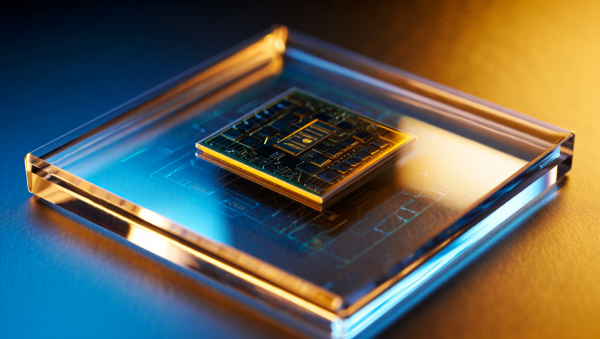
[DigitalToday reporter Jinju Hong (홍진주)] Glass, used by humans for thousands of years, is now emerging as a key material for artificial intelligence (AI) chips. The semiconductor industry sees next-generation chip packaging using glass as a way to address both power issues in AI data centres and limits in computing performance. Technology Review reported on March 13.
Absolics, a U.S. unit of SKC, is preparing commercial production of specialised glass panels for next-generation computing hardware. The company has completed a production plant in the United States for glass substrates used in AI chips and plans to begin small-batch production for customers from this year. Semiconductor company Intel is also conducting research to introduce glass substrates into next-generation chip packages.
At the core of the technology is using glass as the substrate that connects multiple silicon chips. Recent semiconductor designs increasingly use "chip packaging" to combine chips with different functions into a single system. Existing organic substrates, however, can suffer from warpage when heat builds up, which can lead to chip alignment errors or reduced cooling efficiency.
Deepak Kulkarni (디팍 쿨카르니), a researcher at AMD, said, "As AI computing increases, package sizes are getting larger and substrate deformation issues are becoming increasingly serious." He said glass substrates are an alternative that can address these mechanical limits. Glass has high thermal stability and can withstand higher temperatures than existing substrates, while boosting performance and energy efficiency even as package size is reduced.
Semiconductor packaging currently relies heavily on organic substrates such as glass-fibre-reinforced epoxy. Intel's vice president of advanced packaging, Rahul Manepalli (라훌 마네팔리), pointed out that organic substrates have electrical and thermal limits. Using glass substrates can significantly raise interconnect density in the same area, enabling tighter connections between chips. It can also pack up to 50 percent more chips into the same package area.
Glass can also be processed to a very smooth surface, reducing defects that occur during semiconductor manufacturing. According to market research firm IDTechEx, glass substrates can achieve surfaces up to 5,000 times smoother than organic substrates, reducing microscopic defects that can degrade chip performance. Glass also has light-guiding properties, allowing optical-based signal transmission to be implemented within the substrate. That can move data at much lower power than existing copper wiring.
Glass substrates still face technical hurdles. Because they are very thin, at hundreds of micrometres, they can break easily during manufacturing. Intel researchers recently produced a test chip package using glass substrates and said the device successfully ran an operating system.
The growth potential of the glass substrate market is also being raised. IDTechEx forecast the market would expand from about $1.0 billion in 2025 to $4.4 billion in 2036.
Glass substrate technology began in 2009 at the 3D Systems Packaging Research Center at the Georgia Institute of Technology in the United States. Absolics later worked with SKC to build a production facility in Covington, Georgia, in 2024 and received total support of $175 million through the U.S. government's CHIPS for America programme.
Competition around glass substrate technology is also expanding rapidly across the semiconductor industry. South Korean companies including Samsung Electronics, Samsung Electro-Mechanics and LG Innotek are expanding research and pilot production, while components company JNTC is building a facility to produce semi-processed glass panels to expand its participation in the supply chain.
The industry sees glass substrates being applied first to high-performance chips for AI data centres and potentially spreading to laptops and mobile devices if production costs fall. As demand for AI computing grows explosively, attention is focused on whether glass will establish itself as a core material for next-generation computing.
 Jinju Hong
hongjj@d-today.co.kr
Jinju Hong
hongjj@d-today.co.kr