
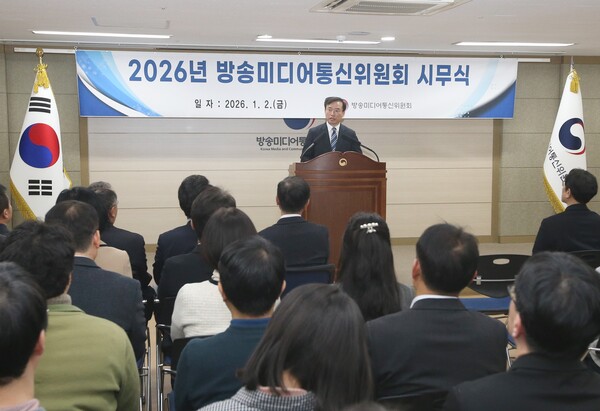
Kim Jong-cheol, chairman of the Korea Broadcasting Media and Communications Commission, stressed he would lead a major transformation of the media ecosystem as a “guardian of the Constitution” and a builder of a fair media order.
In a New Year address on Jan. 2, Kim said he would make this year the first year of reform for broadcasting, media and communications policy. He said he would devote all capabilities to creating a safe, free, fair and innovative media environment.
The commission will build a broadcasting, media and communications ecosystem the public can trust based on three key policies.
It will first focus its capabilities on building a system to prevent the distribution of false and manipulated information. Kim said he would work to form a healthy public sphere where freedom of expression is guaranteed. He said the commission would push legal reforms to strengthen operators’ step-by-step, tailored accountability for illegal and harmful information online.
The commission also decided to swiftly implement a “transmission qualification certification system” that allows only operators with the capacity to prevent illegal spam to enter the bulk text messaging transmission market.
Second, it aims to boost industrial innovation by balancing regulation and promotion. With revenue in the broadcast advertising market sharply declining, it will move to innovate advertising and programming regulations applied only to broadcasting.
Kim said he would revitalise related industries by developing AI technologies for broadcasting and media and improving production-process efficiency. He said the commission would discover and foster new jobs such as digital creators and provide comprehensive support for media startups.
The commission also plans to continue efforts to build an integrated legal framework for media that encompasses both traditional and new media such as broadcasting and OTT, and supports the media industry’s sustainable growth.
Kim stressed that, third, he would work to strengthen the public’s sovereignty in media. He said the commission would speed up the enactment and revision of enforcement decrees and rules to implement amendments to three broadcasting laws, and push legal reforms across the public broadcasting system, including public responsibilities, evaluation and funding.
Kim said he would expand infrastructure to strengthen media access rights for all people and respond to growing demand for mediation in broadcasting, media and communications disputes. He said the commission would also look at expanding relevant organisations and widening the scope of disputes subject to mediation.
He told commission staff they must uphold principles and fundamentals and move forward without wavering. He urged them to work together so the commission can establish itself as a “public communication commission”.
 Jin-ho Lee
jhlee26@d-today.co.kr
Jin-ho Lee
jhlee26@d-today.co.kr