
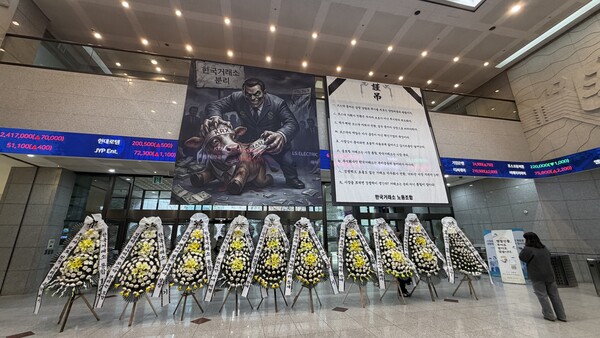
As the ruling camp pushes plans to convert the Korea Exchange into a holding company and separate the Kosdaq market, the exchange's union and the city of Busan have voiced strong opposition.
On Feb. 12, the financial investment industry said the Korea Exchange chapter of the Korean Federation of Office and Financial Service Workers' Union installed more than 10 condolence wreaths and a large banner in the first-floor lobby of the Korea Exchange building in Yeouido, Seoul, on Feb. 10. The messages included "Stop government-led finance through conversion to a subordinate holding company" and "Five parachute jobs created by conversion to a holding company."
The union criticised the plan, calling a Kosdaq split "a return of the dot-com bubble that invites an oversupply of listings and speculation" and "the institutionalisation of a speculative market." It said turning a Kosdaq market that is certain to run a deficit into a subsidiary would ultimately force the market to survive through "indiscriminate listings."
It said separating operation of the Kosdaq market would inevitably weaken market surveillance functions or increase related costs, and would run counter to a global trend toward integrating markets. The union also said converting the exchange into a holding company with neither competitiveness nor efficiency would result only in the creation of five parachute chief executive posts.
The controversy flared after Democratic Party lawmaker Kim Tae-nyeon (김태년) recently introduced a bill to separate the stock market (KOSPI) and the Kosdaq market.
Prime Minister Kim Min-seok (김민석) said on Feb. 11 during a parliamentary question-and-answer session with the government that Kosdaq, like KOSPI, needs change and institutional improvement. He said it would be good to make comprehensive judgments, including Kim Tae-nyeon's proposal, and to establish measures and pursue change through legislation.
Korea Exchange Chairman Jeong Eun-bo (정은보) said at a press briefing on Feb. 5 that he would continue efforts to find a market structure that can win investor trust and achieve the goal of fostering venture companies. He said there could be many possible combinations in terms of substance regarding whether to separate Kosdaq and the method.
Busan Mayor Park Hyung-joon (박형준) strongly criticised the move in a Facebook post that day, saying the government's and ruling camp's actions amount to abandoning past government policies to make Busan a financial hub.
Park said Busan has built a financial ecosystem since being designated a financial hub in 2009, but some core functions of the Korea Exchange are still operated in Seoul. He said the government designating another financial hub and taking away financial functions held by Busan is little different from abandoning the policy of making Busan a financial hub in terms of balanced national development.
He said he cannot accept a Kosdaq split, and that converting the Korea Exchange, the centre of Busan's financial ecosystem, into a holding company could move key functions to the Seoul metropolitan area without clear rules on the headquarters location. He warned that this could reduce Busan's financial status to an empty shell. Park said he would fight, together with 3,200,000 Busan citizens, and would not stand by as the government sidelines Busan.
 Oh Sang-yeop
yub@d-today.co.kr
Oh Sang-yeop
yub@d-today.co.kr