
South Korea's Fair Trade Commission decided to impose corrective orders and total fines of 408.3 billion won on CJ CheilJedang, Samyang Corp and Daehan Sugar for leading collusion on B2B sugar selling prices for more than 4 years.
The FTC said on Feb. 12 the three companies agreed and carried out the size of sugar price increases and decreases and when to apply them in dealings with end users such as beverage and snack makers and in transactions with agents from February 2021 to April last year.
According to the FTC, the three companies aligned price changes 8 times in total, with 6 increases and 2 decreases. When raw sugar prices rose, they coordinated the timing and scale of hikes to quickly reflect rising costs in prices. The FTC also cited cases in which the three cooperated by jointly pressuring customers that did not accept the increases. When raw sugar prices fell, the FTC judged the companies agreed to reduce the scope of sugar price cuts more than the drop in raw sugar and to delay the timing of reductions.
The three companies were sanctioned on the same charges in 2007, but collusion was again detected this time. According to the FTC, the three also communicated only through in-person meetings and phone calls to thoroughly conceal the collusion.
The FTC explained that the collusion continued for more than a year even after it began an on-site inspection in March 2024, and that it also confirmed signs the firms shared information on the probe and discussed a joint response. The FTC added that 3 corporate entities and 11 executives and employees, for which prosecutors requested a complaint from September to November last year, have already been reported to prosecutors.
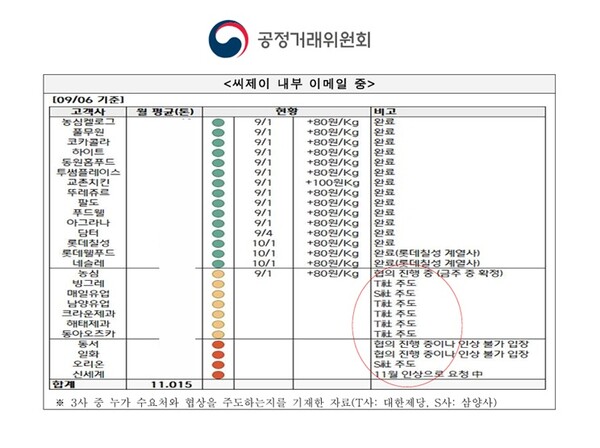
The FTC said the collusion was carried out through meetings and contacts by rank, including representative-level, division head-level, sales executive-level and sales team leader-level. Senior ranks decided the broad framework for hikes. Investigators found sales organizations met about 9 times a month to align detailed implementation plans, including the timing of talks by customer and how to respond when negotiations stalled. Negotiations with each customer proceeded in a way in which the company with the higher market share led and shared progress.
Internal 자료 released by the FTC also included content stating which of the three companies led negotiations with customers.
According to the FTC, the fines are the second-largest in total amount among the FTC's cartel cases. Fines by company are 150.7 billion won for CJ CheilJedang, 130.3 billion won for Samyang Corp and 127.4 billion won for Daehan Sugar.
The FTC ordered measures to prevent recurrence, including a ban on illegal acts, reporting of price change details, notification of the legal violations, employee training, internal probes by sales teams and new rules for disciplining participants in collusion. It ordered the companies to submit written reports twice a year on sugar price changes over the next 3 years.
According to FTC data, the sugar market is an oligopoly dominated by a small number of companies, and the combined share of the three companies based on domestic sales volume in 2024 is about 89 percent.
The FTC said, "It will help stabilize high food prices that the public has recently been feeling firsthand and sound an alarm about unfair price rises by monopolistic and oligopolistic businesses," adding, "The sugar sector is a market in which a small number of businesses form an oligopoly and is therefore vulnerable to collusion, so we expect that by continuously checking future price change trends through orders such as reporting on price change status, we can block the possibility of collusion and promote competition."
[Yonhap News Agency]
 Online Team
d-today@d-today.co.kr
Online Team
d-today@d-today.co.kr