
From July, delisting standards for Kosdaq-listed companies will be significantly tightened, including bringing so-called penny stocks priced below 1,000 won into the scope of delisting.
The Financial Services Commission and Korea Exchange on Feb. 11 announced a delisting reform plan to swiftly and strictly remove troubled companies.
It comes about 2 weeks after President Lee Jae-myung likened the stock market to a "department store" on his X (formerly Twitter) account on Jan. 29 and said, "If there are many rotten products and fake products with no product value, who would go?"
Over the past 20 years, the Kosdaq market has maintained a structure of many listings but few delistings, with 1,353 companies newly listed and 415 companies removed. In that process, market capitalisation rose 8.6-fold, but the index increased only 1.6-fold.
Financial authorities forecast that strengthening delisting requirements, including introducing a penny-stock trigger, could increase the number of Kosdaq-listed firms subject to delisting this year from an existing estimate of around 50 to about 150, and up to about 220. That would be about 10 percent of Kosdaq-listed companies.
The FSC will comprehensively strengthen four key delisting requirements from July 1. The main measure is introducing a delisting trigger for penny stocks priced below 1,000 won.
Penny stocks were considered because they tend to have high price volatility and low market capitalisation, and are easily targeted for stock manipulation. The U.S. Nasdaq market also operates delisting requirements related to so-called penny stocks priced below $1.
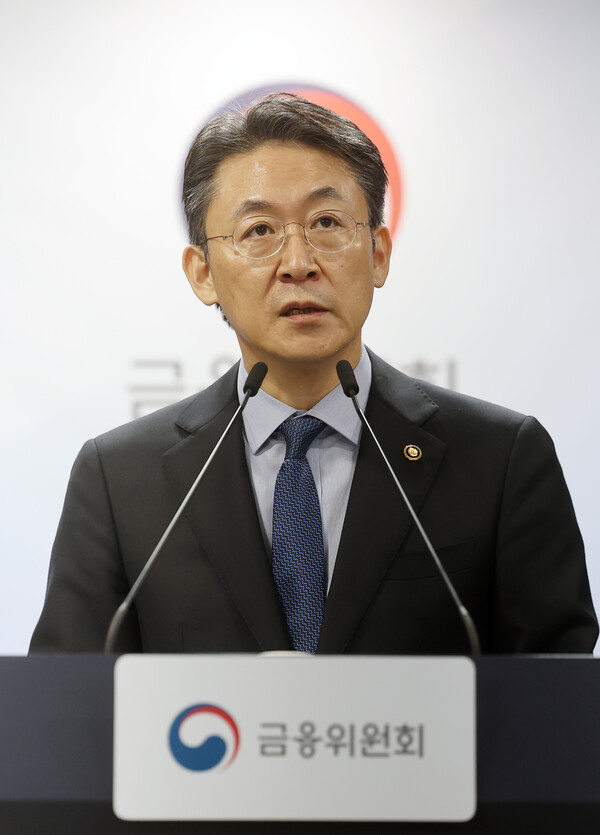
FSC Vice Chairman Kwon Dae-young (권대영) said penny stocks often did not trade actively but had a high likelihood of suddenly surging or becoming targets for mergers and acquisitions. He said clearly addressing Kosdaq market "arteriosclerosis" caused by such factors would help the capital market.
If a stock stays below 1,000 won for 30 consecutive trading days, it will be designated as an issue under administrative watch. It will be delisted if it fails to recover to 1,000 won or more for 45 consecutive trading days within the following 90 trading days.
To prevent formal avoidance through stock consolidation, the plan will also include companies for delisting if, after consolidation, the share price is below par value.
The timetable for raising the market-capitalisation threshold will also be brought forward.
The threshold, initially planned to rise each year, will be accelerated to a semi-annual schedule, strengthening it to 20 billion won in July this year and 30 billion won in January next year.
Detailed application standards and market surveillance will be strengthened to prevent companies from avoiding delisting through a temporary boost in share prices.
If a company fails to restore the market-capitalisation threshold for at least 45 consecutive trading days during the 90 trading days after being designated under administrative watch, it will be immediately delisted.
The requirement related to full capital impairment will also be strengthened, expanding the current application based only on the end of the fiscal year to include a half-year basis.
Disclosure-violation standards will be tightened to 10 penalty points from 15 cumulative points over the past year. Serious and intentional disclosure violations will be included in delisting review targets even with a single violation.
The same strengthening of the four key requirements will also apply to the KOSPI market.
Korea Exchange will form a "delisting intensive management task force" led by an executive director in charge at its Kosdaq division and operate an intensive management period from Feb. 12 through June 2027.
It will operate a total of 4 teams and 20 people, adding 1 recently created team to the existing 3 delisting review teams, and will further reinforce staffing if necessary.
Intensive management performance will be reflected in the exchange's 2026 management evaluation with a 20 percent weighting. The policy is to strengthen accountability by linking delisting performance to management evaluation.
Delisting procedures are expected to be shortened, speeding up removals.
In Kosdaq substantive reviews, the maximum improvement period that can be granted to companies will be reduced to 1 year from the current 1 year and 6 months. It also plans to pursue discussions with courts so that injunction lawsuits related to delisting are not delayed.
In a simple simulation based on current conditions, the exchange estimated that reflecting the measures would increase the number of Kosdaq firms subject to delisting this year by about 100 from the existing estimate of around 50, to around 150.
It also presented a forecast that the number of Kosdaq firms subject to delisting could reach up to about 220 depending on whether penny stocks conduct stock consolidations.
Efficiency measures for delisting procedures will take effect from April 1, and the strengthening of the four key requirements will take effect from July 1.
Kwon said no unfair practices such as accounting fraud or stock manipulation would be tolerated in the process. He said it would also pursue improvements to listing systems so that vacancies left by delisted troubled companies are filled by promising innovative companies.
Financial authorities introduced a tailored technology-special listing system at the end of last year for the artificial intelligence, space and energy industries. They plan to expand the range of innovative technologies subject to tailored reviews this year.
Some voices have also raised concerns about confusion among companies and investors due to tighter delisting requirements.
Kwon said it should have been done earlier and, in some respects, it was rather late. He said he thought cleaning up the market once and moving on might be better for the distant future.
The FSC and the exchange plan to hold a session to hear opinions from companies after the Lunar New Year holiday.
They also said they will create a delisted companies section on the K-OTC over-the-counter market to support delisted companies so they can relist.
Separately, some analysis also says cleaning up troubled companies on Kosdaq would help the index rise further.
Lee Sang-ho (이상호), a research fellow at the Korea Capital Market Institute, said an analysis showed that if, from 2011 onward, companies with an interest coverage ratio below 1 for 3 consecutive years as of each June were excluded from the index and it was recalculated, the Kosdaq index as of end-June 2024 would rise an additional 37 percent.
[Yonhap News Agency]
 Online Team
d-today@d-today.co.kr
Online Team
d-today@d-today.co.kr