
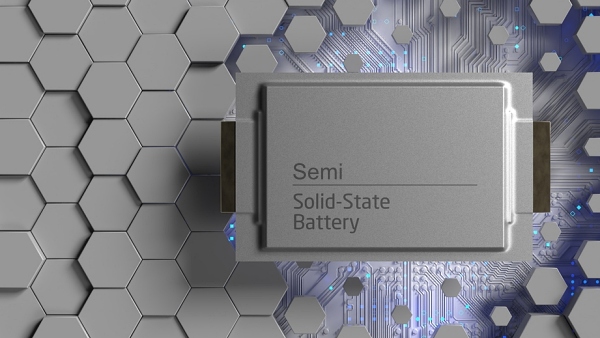
Global automakers and battery makers are speeding up efforts to commercialise all-solid-state batteries that promise breakthroughs in energy density, charging speed and driving range. As the technology is seen as a next-generation option that can go beyond the limits of existing lithium-ion batteries, major companies are seeking to secure technological leadership through pilot production and deployment in actual vehicles.
Against that backdrop, China's state-owned automaker First Automobile Works (FAW) Group said on Feb. 10 (local time) it has become the first in the industry to fit a lithium-rich manganese-based semi-solid battery in an electric vehicle.
According to electric vehicle outlet The Electric, the battery was jointly developed by FAW's battery unit and researchers at Nankai University, and has a cell energy density exceeding 500 Wh/kg. That is sharply higher than current commercial lithium-ion batteries at about 250 to 300 Wh/kg. The company said the 142 kWh pack supports a driving range of more than 1,000 km under the CLTC standard. If the technology is implemented as planned, some assessments say it could shake up competition in the long-range electric vehicle market.
Earlier, China's SAIC Motor launched what it called the world's first mass-produced semi-solid electric vehicle, the MG4, and Dongfeng Motor is also testing a solid-state battery prototype capable of driving more than 1,000 km in extreme conditions. Chinese companies are pursuing a multi-pronged technology strategy, advancing not only manganese-based technology but also high-nickel NCM (nickel-cobalt-manganese) and NCA (nickel-cobalt-aluminium) batteries. The moves are seen as aimed at securing an edge in cost competitiveness and access to resources.
All-solid-state batteries are known to improve safety by using a solid electrolyte instead of a liquid one, and can theoretically deliver up to twice the energy density of conventional lithium-ion batteries. Challenges that remain include ion conductivity of solid electrolytes, interfacial resistance and stability in mass-production processes. As a result, semi-solid technology that mixes liquid and solid materials is emerging as a transitional alternative rather than fully solid-state designs.
Global automakers and battery companies have also joined the development race. Toyota, BYD, CATL, Volkswagen, Mercedes-Benz and BMW are working to develop sulphide-based all-solid-state batteries. Toyota is targeting commercialisation in 2027 to 2028, while BYD also plans to start producing all-solid-state batteries from 2027. Initial output is likely to be small-scale and focused on premium models.
Some are already conducting demonstration tests of all-solid-state batteries. Mercedes said it succeeded in driving 1,205 km with a modified EQS equipped with an all-solid-state battery, while U.S.-based Factorial Energy is working with Hyundai Motor and Stellantis, among others, to push commercialisation. Across the industry, a scenario is widely discussed in which pilot production in 2027 to 2028 is followed by full-scale mass production around 2030.
SNE Research said CATL and BYD are expected to account for more than 55 percent of global electric vehicle battery usage in 2025. That means Chinese companies are rapidly expanding their influence in both technology development and production capacity. Market attention is focused on whether all-solid-state batteries can overcome technical hurdles and build a mass-production system, and who will be the first to commercialise them.
 Jinju Hong
hongjj@d-today.co.kr
Jinju Hong
hongjj@d-today.co.kr