
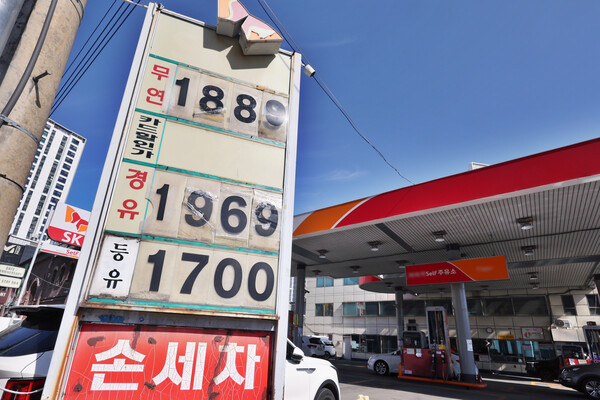
On March 13, as an oil price cap took effect, average fuel prices at gas stations nationwide extended a three-day decline.
According to Opinet, the Korea National Oil Corp's oil price information system, the national average price of gasoline stood at 1,893.3 won per litre as of 2 a.m., down 5.5 won from the previous day.
Diesel stood at 1,911.1 won at the same time, down 7.9 won. Diesel prices remain higher than gasoline prices.
Fuel prices in Seoul also continued to fall.
The average gasoline price in Seoul was 1,918.9 won per litre, down 8.1 won from the previous day.
The average diesel price in Seoul was tallied at 1,922.7 won, down 13.5 won.
Fuel prices at domestic gas stations have continued to fall since hitting a peak on March 10 after the outbreak of the U.S.-Iran war.
On March 12, the national average gasoline price was 1,898.8 won and the diesel price was 1,919.0 won, down 5.5 won and 8.5 won, respectively, from the previous day.
From midnight on March 13, the government implemented an oil price cap, setting maximum refinery supply prices per litre at 1,724 won for regular gasoline, 1,713 won for automotive diesel and 1,320 won for indoor kerosene. It plans to reassess the Middle East situation and oil price trends and reset the cap every two weeks.
International oil prices surged again after Ayatollah Seyyed Mojtaba Khamenei, elected as Iran's new supreme leader, declared an ultra-hardline response toward the United States and Israel. At ICE Futures, Brent crude futures for May delivery settled at $100.46 a barrel, up 9.2 percent from the previous session. It was the first time it closed above $100 since August 2022, the first in 3 years and 7 months.
Changes in international oil prices are typically reflected in domestic gas station prices with a lag of about 2 to 3 weeks.
[Yonhap]
 Online Team
d-today@d-today.co.kr
Online Team
d-today@d-today.co.kr