
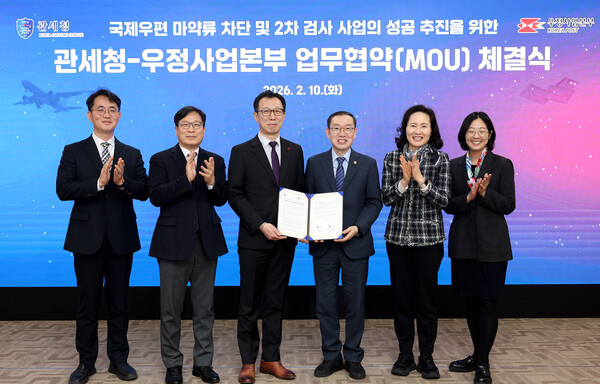
A secondary drug inspection system being piloted at the Dong Seoul Mail Center will be expanded to major regions nationwide, including Busan, to block drugs from entering South Korea through international mail.
Korea Post under the Ministry of Science and ICT and the Korea Customs Service on Feb. 10 signed a business agreement at Seoul Customs to ensure the successful rollout of a project to block narcotics in international mail and conduct secondary inspections.
Under the agreement, a “second line of defence” for drug inspections will be built at mail centers, key logistics hubs, in addition to the existing airport-centered inspection system. International mail that has completed a first inspection at an airport will undergo another detailed customs inspection when it arrives at a mail center.
The two agencies have run a pilot secondary narcotics inspection for international mail since Dec. 29 last year, after designating the Dong Seoul Mail Center as a customs clearance post office. They agreed to expand the system to major regions nationwide, including the Busan Mail Center and the Central Region Integrated Mail Logistics Center, and to conduct inspections on all international mail through a redesign of the logistics network.
The number and value of drug detections through international mail have recently been declining. The number of cases fell to 318 in 2025 from 780 in 2021. The value of detected shipments also decreased to 10.7 billion won from 36.8 billion won over the same period.
Kawk Byung-jin (곽병진), acting head of Korea Post, said it was meaningful for the agency to contribute to the national task of blocking drugs. He said it would actively cooperate with the Korea Customs Service to provide a safe postal service that the public can use with confidence.
Korea Customs Service Commissioner Lee Myung-goo (이명구) said an opportunity had been created to expand the Dong Seoul Mail Center’s secondary line of defence to inland areas nationwide. He said the customs service would make an all-out effort to restore the country’s status as a drug-free nation through close cooperation with Korea Post.
 Jin-ho Lee
jhlee26@d-today.co.kr
Jin-ho Lee
jhlee26@d-today.co.kr