
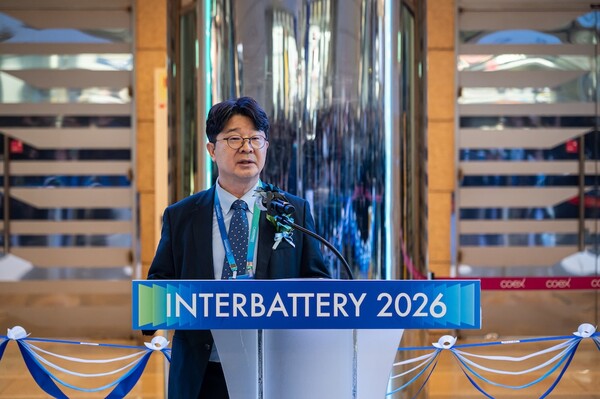
International battery exhibition InterBattery 2026 opened at COEX in Seoul on March 11 for three days. The 14th edition features 667 companies from 14 countries operating 2,382 booths, the biggest scale in the event’s history.
Eom Gi-cheon (엄기천), chairman of the Korea Battery Industry Association, said in opening remarks that InterBattery has now established itself as a central stage for the global battery business. He set out tasks for K-batteries including securing first-mover advantage in new-demand markets, joint technology development between cell and materials companies, AI-based manufacturing innovation and building a circular economy system.
In line with that, this year’s key exhibition agenda is energy storage systems (ESS). As a response to short-term market changes including slowing demand for electric vehicles, ESS, which is growing rapidly on expanding renewable energy and demand for AI transition, was presented as an alternative. Companies shared strategies to expand their ESS businesses and trends in technology development, and the event also addresses market strategies to respond to changes in the trade environment such as U.S. tariff policies and EU battery regulations.
On next-generation technologies, development directions were presented for all-solid-state batteries, sodium batteries and silicon anode materials. Measures to strengthen safety, including structural design and materials innovation to respond to thermal runaway, are also discussed, and the event plans to look at the potential for battery use in new industrial areas such as defence, robotics and urban air mobility (UAM).
The exhibition includes about 180 overseas participants. Governments, research institutes and companies from countries including the United States, Australia, Canada, Germany, China, Japan and the Netherlands took part, forming a global cooperation network. During the event, cooperation on South Korea-U.S. defence battery technology, business networking between South Korean and German battery researchers, and cooperation with Australia on core-mineral supply chains are also expected to be mentioned.
The event ran a procurement consultation programme for shared growth cooperation with purchasing staff from the three battery companies taking part. It is designed to help materials, parts and equipment companies enter supply chains. An investor relations pitching event with venture capital firms invited was also set up to link startups with investment opportunities, and a battery job fair offered an employment package including one-on-one mentoring on job roles.
Moon Shin-hak (문신학), vice minister of the Ministry of Trade, Industry and Energy who attended the opening ceremony, said the government would actively support K-batteries so they can maintain a leading position at a time when the industry faces challenges such as an electric-vehicle market chasm and uncertainty in the global trade environment, alongside opportunities including expanding new demand and supply chain reshuffling.
He added that the government would revitalise downstream demand through steps such as expanding the ESS market and introducing a battery leasing system, push to introduce a production tax credit in the battery sector to strengthen the domestic production base, and make a leap to become a hub for global battery manufacturing by creating a battery triangle belt that runs from core minerals to materials to mother factories.
 Dae-geon Seok
d2dg@d-today.co.kr
Dae-geon Seok
d2dg@d-today.co.kr