
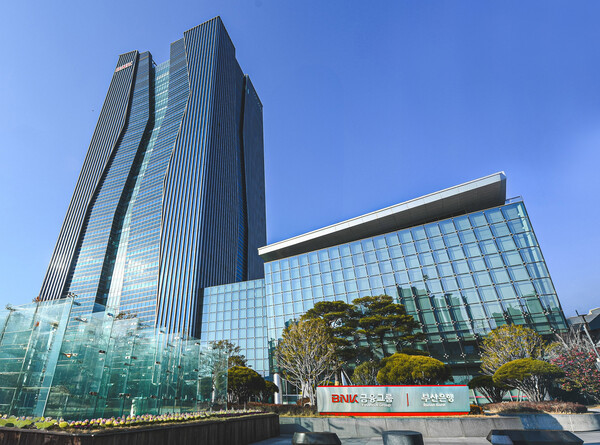
Three regional financial holding firms (BNK, JB and iM) that posted record results last year are putting non-bank businesses at the forefront as a new growth pillar this year. Attention is on what differentiated non-bank competitiveness each holding firm will show.
The combined net profit of the three regional financial holding firms last year was 1.97 trillion won, up 21.5 percent from a year earlier, the financial sector said.
BNK Financial Group posted net profit of 815.0 billion won last year, keeping the largest profit 규모 among regional financial holding firms. The increase rate was 11.9 percent from a year earlier. It posted a record annual result and showed a stable growth trend.
Banks were at the center of the group's performance. Net profit from the banking segment was 732.1 billion won, accounting for a large portion of total profit. Busan Bank posted 439.3 billion won and Kyongnam Bank 292.8 billion won in net profit.
Net profit from the non-bank segment was 188.1 billion won, about 23 percent of the total. Major affiliates such as capital, investment securities and asset management were evenly reflected. BNK Capital in particular led non-bank net profit with 128.5 billion won.
JB Financial Group posted net profit of 710.4 billion won last year. It was up 4.9 percent from a year earlier, also marking a record result.
The key was JB Woori Capital. JB Woori Capital posted net profit of 281.5 billion won, up 25.8 percent from a year earlier, becoming the group's most profitable affiliate. Phnom Penh Commercial Bank (PPCBank) in Cambodia also posted net profit of 48.6 billion won, supporting the overseas non-bank segment.
A notable point was that non-bank affiliates exceeded the net profit of the group’s flagship bank affiliates. The banking segment was relatively sluggish last year. Jeonbuk Bank posted a slight increase to 228.7 billion won. Gwangju Bank’s net profit fell 5.5 percent from a year earlier to 272.6 billion won as both interest income and non-interest income declined.
iM Financial logged the biggest rebound in performance last year. Annual net profit jumped 106.6 percent from a year earlier to 443.9 billion won.
Non-bank businesses were at the center of the rebound. iM Securities, which had posted losses for five consecutive quarters, returned to profit with annual net profit of 75.6 billion won. After proactively setting aside provisions related to project financing, its burden of credit loss costs fell sharply in 2025, leading the normalisation of non-bank businesses.
iM Capital also saw a big improvement in profit alongside asset growth. Assets rose 28.9 percent from a year earlier and net profit improved 60.7 percent to 54.0 billion won.
The banking segment was also stable. iM Bank posted net profit of 389.5 billion won, up 6.7 percent from a year earlier. Interest income was weak through the first half due to the impact of rate cuts, but it showed a gradual recovery trend after bottoming out in the first quarter. Non-interest income improved by more than 160 percent from a year earlier on the back of an active expansion of trading gains.
◆ This year’s battleground is 'non-bank'... differentiated strategies in focus
All three regional financial groups are calling for 'strengthening non-bank' businesses. Differences are likely to show up in results in earnest this year.
BNK Financial is focusing on growing its capital markets business centred on investment securities and asset management. It set a strategy to expand non-bank businesses in stages based on stable profits from banking.
In its earnings conference call, BNK Financial also presented a specific net profit target for BNK Investment & Securities this year and said it plans to grow the capital markets segment as a key pillar for expanding non-interest income.
Jong-hoon Kang (강종훈), BNK Financial’s chief financial officer, said, "This year, we expect non-interest income on the capital markets side," adding, "Investment securities will earn about 90.0 billion won in net profit this year."
JB Financial has consistently worked to strengthen its non-bank business since Ki-hong Kim (김기홍) took office as chairman of JB Financial. As a result, capital and other units have become a key axis of the group’s performance. As JB Capital grew, CEO Chun-won Park was also appointed as the new head of Jeonbuk Bank.
JB Financial plans to further solidify this non-bank-centred portfolio. Kim said, "We will review the results and profitability of various new businesses and growth strategies 추진해온 so far, and more clearly reorganise the mid- to long-term growth foundation."
iM Financial is also redefining non-bank businesses as a growth engine, using the normalisation of its securities and capital units as a foothold. A key question is whether other non-bank units such as iM Life and iM Asset Management can sustain a recovery in the rebound phase.
Byeong-gyu Cheon (천병규), iM Financial’s chief financial officer, said in a conference call, "Capital has a capital markets dependency close to 100 percent, so the effect of reduced funding costs from a credit rating upgrade will be large," adding, "Reflecting this, we set this year’s business plan aggressively." He also explained that in the securities segment it reshuffled its portfolio centred on safe assets and established a system to manage earnings volatility, and set a return-on-equity target at around 8 percent to make a meaningful contribution to the group.
He added, "We agree that non-bank net profit needs to increase," and said, "Securities has established a system to manage earnings volatility, and for capital as well, we expect the effect of reduced funding costs from the credit rating upgrade to materialise in earnest."
 Ji-young Lee
ljy@d-today.co.kr
Ji-young Lee
ljy@d-today.co.kr