
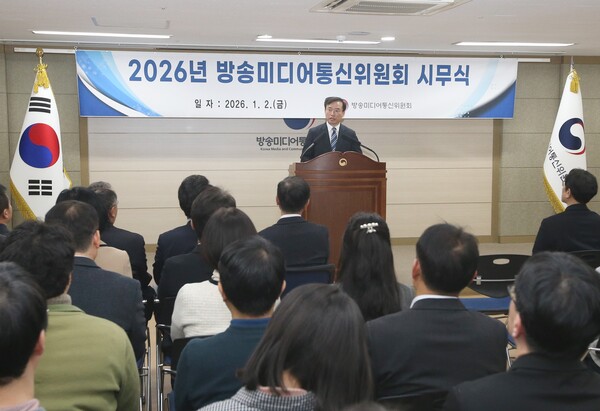
Delays in appointing opposition-nominated members in the National Assembly mean it remains unclear when the Broadcast Media Communications Commission will return to normal operations with a seven-member lineup.
Under the commission’s founding law, it has 7 members in total. The president nominates 2 and the National Assembly recommends 5, with 2 from the ruling party and 3 from the opposition. A plenary meeting can open if at least 4 of the 7 incumbent members attend.
The commission currently has only 2 members in place: Chairman Kim Jong-cheol (김종철), a presidential appointee, and Ryu Shin-hwan (류신환), a standing member. The ruling Democratic Party has selected Ko Min-su (고민수), a law professor at Gangneung-Wonju National University, as a candidate for a standing member and Yoon Sung-ok (윤성옥), a professor in media and film studies at Kyonggi University, as a candidate for a non-standing member.
If the 2 Democratic Party nominees are appointed in addition to Kim and Ryu, meetings can be held. Some in the industry see the commission’s formation under a “four-member system” as imminent, but the commission is drawing a line against that description.
With a full lineup consisting of 2 presidential appointees, 2 ruling party nominees and 3 opposition nominees, the commission is wary that decisions made only by the 4 presidential and ruling party figures could be seen as unilateral. This is understood as an effort to pre-empt controversy over damage to political neutrality as a consensus-based administrative body.
Still, the prevailing view in the industry is that concerns will be difficult to fully dispel. Critics say that if meetings are held with 4 members while the 3 opposition-recommended seats are vacant, major decisions could be made with the balance tilted toward one political camp. An industry official said, "Even if there is no legal problem, whether it matches the intent of a seven-member consensus-based body is a separate issue." The official added, "Especially issues involving conflicting interests, such as licensing approvals or sanctions, could be drawn into controversy."
Some also worry the delay in appointing National Assembly nominees could weaken the commission’s momentum on policy. The commission currently faces a buildup of pending issues, including broadcasting re-licensing and platform and telecommunications matters. Critics say if the lineup continues to be delayed, it could miss a golden time window.
The commission said it will watch how member appointments unfold. It said that even if 2 opposition-nominated members are appointed and the quorum for holding meetings is met, further discussions are needed on whether meetings will actually be convened. The nameplate spot at the commission has remained empty for more than 4 months since its launch. The commission plans to hold a nameplate ceremony after the seven-member lineup is completed.
Signs of fatigue are also emerging inside the commission. Observers say there is an atmosphere of caution even over wording, mindful of factional controversy. A person familiar with commission news said, "Inside the commission, they do not use the term 'four-member system' much." The person added, "They only say it as two people named by the president, two recommended by the National Assembly, three people, in that way."
 Jin-ho Lee
jhlee26@d-today.co.kr
Jin-ho Lee
jhlee26@d-today.co.kr