
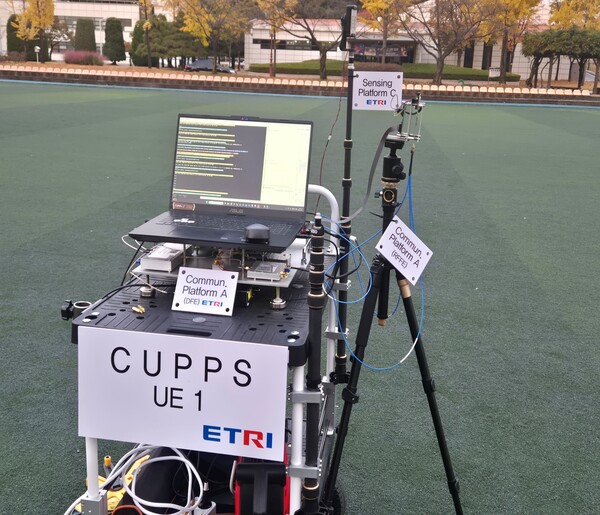
South Korea's Electronics and Telecommunications Research Institute (ETRI) said on Tuesday it has developed, for the first time in the world, core technology for a "communications-assisted ultra-precise and ultra-low-power sensing system (CUPPS)" that integrates communications and sensing into a single system.
In a 6G environment, higher frequency bands can be used to secure wider bandwidth, which is expected to greatly improve sensing accuracy as well as communications speed. As a result, an integrated structure that performs both functions simultaneously on a single carrier is emerging as a key technology, moving away from the existing structure in which communications and sensing are operated separately.
The CUPPS technology developed by ETRI is characterized by separating the roles of communications and sensing within a 6G integrated structure. Communications maintains connectivity and controls sensing timing. The sensing function of detecting actual location is designed to be performed by an ultra-low-power tag mounted on the device. This secures both frequency-use efficiency and sensing precision.
Current 5G-based sensing uses a round-trip time (RTT) method in which the device receives and processes a signal and then transmits it again, which has limitations including delays in the device's transmit-and-receive processing and high power consumption. By contrast, CUPPS precisely coordinates sensing timing through beamforming-based communications, and the device performs sensing by operating the ultra-low-power tag only when needed. This structurally reduces the device's power burden during sensing.
Researchers said outdoor tests succeeded in measuring the locations of multiple devices with about 350 times higher precision than the target accuracy of existing 5G RTT, even in strong-interference environments. They also confirmed that the method of operating the tag only when sensing is needed can reduce device power consumption by more than 90 percent compared with existing approaches.
Kap-seok Jang (장갑석), chief technology officer at ETRI's 6G wireless transmission research lab, said: "This technology is the first case in the world to implement, in an ultra-low-power manner, a function in which communications networks go beyond simply delivering data to precisely perceive the surrounding environment."
 Jin-ho Lee
jhlee26@d-today.co.kr
Jin-ho Lee
jhlee26@d-today.co.kr