
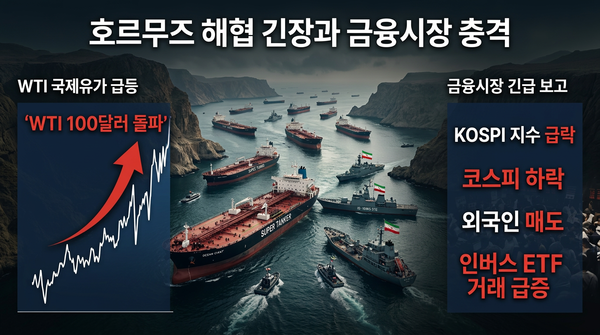
South Korea's KOSPI plunged as worries spread that a sharp rise in oil prices sparked by the Iran situation could reignite U.S. inflation.
On March 9, the KOSPI ended down 333.41 points, or 5.97 percent, at 5,251.46 from the previous session. It also triggered a circuit breaker for the second time this month.
It was the first time circuit breakers were activated twice within a month since March 2020 during the COVID-19 pandemic. The KOSDAQ also fell 6.0 percent at the same time, extending a broad selloff.
The KOSPI slid nearly 20 percent in the shortest period from its March peak, posting a drop close to the largest decline in its history.
The main driver of the slump was a surge in international oil prices. As Asian stock markets opened on March 9, West Texas Intermediate crude (WTI) rose above $100 a barrel for the first time since July 2022, and Brent and WTI each climbed past $116.
WTI, which rose about 30 percent over the past week, surged another roughly 25 percent in a single day to reach the $110 range. It came after the Strait of Hormuz was effectively blocked following U.S. and Israeli military operations against Iran on Feb. 28, cutting off the world's largest oil shipping route that had carried about 20 million to 22 million barrels a day.
Some analysis says the current oil shock is structurally more dangerous than during the 2022 Russia-Ukraine war.
This surge in oil prices is fueling stagflation fears across global financial markets.
Kim Seok-hwan (김석환), a researcher at Mirae Asset Securities, said oil prices have already jumped more than 20 percent from the start of the year and companies are likely to pass tariff and energy costs on to consumers, which could further drive up consumer and producer prices. He pointed to added oil-price pressure on inflation that is already stuck in the 2 to 3 percent range as the biggest threat to the U.S. market.
A U.S. February jobs report released on March 7 local time showed 92,000 jobs were lost. Under normal circumstances, that would raise expectations for U.S. Federal Reserve rate cuts, but the surge in oil prices has raised the risk that inflation will accelerate again, and markets are instead taking it as a stagflation signal.
The International Monetary Fund (IMF) forecast that if a 10 percent rise in oil prices persists for 1 year, global inflation would increase by 40 basis points and global economic growth would slow by 0.1 to 0.2 percentage points.
Against this backdrop, foreign investors have sold a net 38 trillion won in South Korean stocks so far this year, including intraday estimates, on March 9. The selling has been particularly pronounced in top market-cap firms such as Samsung Electronics and SK Hynix.
As the KOSPI remains in a correction phase, defense stocks have been cited as typical war beneficiaries as geopolitical anxiety deepened over the Middle East situation. But they fell sharply on the day amid profit-taking and the oil-price surge.
Trading in inverse products that move opposite the index jumped. KODEX 200 Futures Inverse 2X surged 16.85 percent intraday on March 9, with volume reaching 5.3 billion shares, as bets on the market's direction increased sharply.
As of the previous day, KODEX 200 Futures Inverse 2X also posted trading volume of more than 8.1 billion shares, underscoring a noticeable rise in demand for inverse ETFs this month.
The exchange rate is also nearing the psychological resistance level of 1,500 won, heightening worries about a vicious cycle that would push up import prices. If the current oil-price trend continues, the possibility has also been raised that gasoline prices could soon exceed 2,000 won.
Han Ji-young (한지영), a researcher at Kiwoom Securities, said most of what created this situation is the oil-price surge caused by war, so investors need to keep watching the direction of oil prices. He added that the KOSPI's forward price-to-earnings ratio had already fallen last week to 8.1, a historic low level, and that it has in some ways priced in this war risk ahead of other markets.
 Sangyeop Oh
yub@d-today.co.kr
Sangyeop Oh
yub@d-today.co.kr