
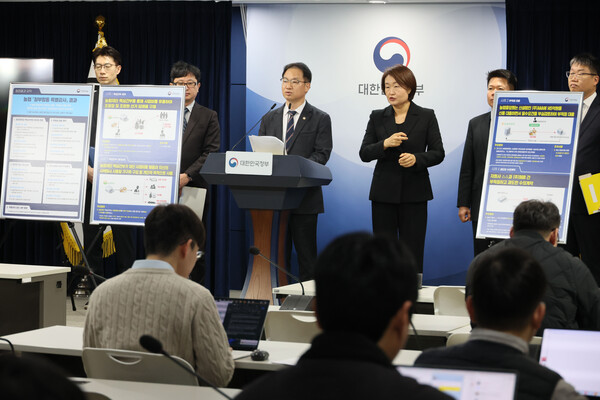
A government special audit of NH found its chairman and key executives were involved in various alleged misconduct cases, including providing money and gifts linked to elections.
On March 9, the government said it would refer a total of 14 cases for investigation. Of those, 6 involved the chairman of the National Agricultural Cooperative Federation and key executives. The government said it confirmed illegal acts, abuses of authority and wasteful budget spending by key executives, and pointed to failed internal controls and an election system vulnerable to money and gifts as causes.
The audit found that Kang Ho-dong (강호동), chairman of the National Agricultural Cooperative Federation, is suspected of using NH Nonghyup Foundation project funds in 2024 and 2025 to prepare gifts and return presents to be provided to heads of member cooperatives and others who helped him in the chairman election. The cost spent on such return gifts totalled 490 million won.
It also confirmed that he received a 10-don gold key, worth about 5.8 million won at the time, from heads of member cooperatives under the pretext of marking the first anniversary of his inauguration, raising the question of whether it violated the Anti-Graft Act.
The audit also confirmed cases of the chairman's unilateral management, including failure to implement a board resolution on organisational restructuring, arbitrary spending of bonus payments and a lack of transparency in managing foundation funds.
The use of "jiksang" payments, a form of employee bonus, was also cited as a problem. Over the past 5 years, total jiksang payments came to 7.5 billion won, and about 4 billion won of that was paid by the chairman. The government said it found cases where payments were made as favours to specific cooperatives or departments without performance evaluations.
Signs of interference in personnel matters at subsidiaries were also confirmed. Some executives, including the federation's executive director, held personnel consultations with NH Bank employees despite having no personnel authority, and the human resources and general affairs division was found to have conveyed the consultation results to NH Bank.
The audit also found cases of preferential loans and investments, including the handling of credit loans at the request of Nonghyup Agribusiness Group and loans to firms where retired executives were re-employed. It also found contracts on terms favourable to counterparties and a practice of private contracts in the contracting process at affiliates.
At the federation and member cooperatives, the audit found wasteful budget spending, including various allowances, commemorative gifts and farewell payments.
NH provided tablet PCs to non-executive directors upon taking office and paid annual activity allowances of 50 million to 60 million won. It also provided a 500,000 won deliberation allowance each time a board meeting was held. At a delegates' meeting in 2022, smartphones worth 2.04 million won were given to about 1,100 attending cooperative heads.
It also paid federation executives, upon retirement, a 10 million won merit payment, travel vouchers worth 5 million won and 10 don of pure gold as farewell payments. Some subsidiaries also held expensive overseas training programs for cooperative heads and others.
The government's special audit team said the federation's budget management and internal control system were also inadequate. Budgets without predefined spending items accounted for 60 percent of the total, and in 2024 spending exceeded budgets by a total of 22.2 billion won across 7 items.
It also raised concerns about conflicts of interest, saying 159 of 195 non-executive directors, or 81.5 percent, at 17 affiliates under the federation and Nonghyup Agribusiness Group were former cooperative heads, while external experts numbered 10, or 5.1 percent.
The government said compliance officers and the audit committee were made up mainly of internal personnel, weakening meaningful checks. It said 3 of the audit committee's 5 members were former or incumbent cooperative heads, and 2 of them concurrently served as incumbent cooperative heads.
 Ji-young Lee
ljy@d-today.co.kr
Ji-young Lee
ljy@d-today.co.kr