
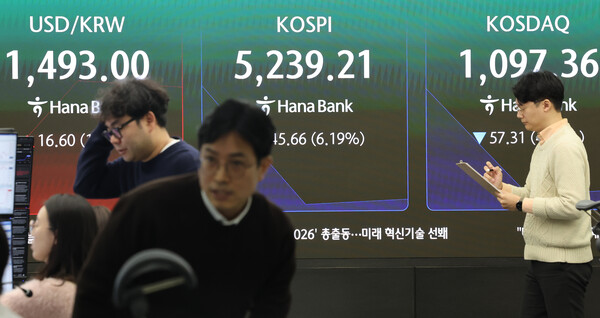
[Digital Today reporter Sangyup Oh (오상엽)] On March 9, sell-sidecar curbs and circuit breakers were triggered in South Korea's stock market, temporarily halting trading.
In the main board market, a sell-sidecar was triggered at 9:06 a.m.
The measure halted the validity of program trading sell orders for 5 minutes after the nearest-month KOSPI 200 futures contract plunged 6.49 percent to 773.90 points from the previous session's close of 827.65. Net program selling at the time totaled 272.1 billion won.
In the KOSDAQ market, a sell-sidecar was triggered at 10:31 a.m.
The move followed a simultaneous decline, with KOSDAQ 150 futures falling to 1,930.00 points from 2,059.30, down 6.27 percent, and the KOSDAQ 150 index sliding to 1,929.16 from 2,060.23, down 6.36 percent. Net program selling was 259.4 billion won.
At the same time, a first-stage circuit breaker was also triggered as the KOSPI fell 452.80 points, or 8.10 percent, to 5,132.07 from the previous session's close of 5,584.87.
It was the second trigger this year and the eighth on record. The circuit breaker halted trading for 20 minutes in all main board issues and related derivatives.
The Korea Exchange cited the impact of a sharp rise in oil prices originating in the Middle East and concerns about a prolonged U.S.-Israel-Iran war as reasons for the trigger.
A first-stage circuit breaker is triggered when the KOSPI falls more than 8 percent from the previous session's close and the decline lasts for 1 minute, and is lifted all at once after 20 minutes.
After the lifting, a single-price auction is held for 10 minutes before switching to continuous trading.
 Sangyup Oh
yub@d-today.co.kr
Sangyup Oh
yub@d-today.co.kr