
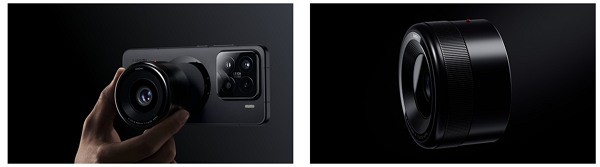
Xiaomi is bringing to life the Modular Optical System (MOS) it unveiled as a concept in 2025, signalling a shift in smartphone photography technology.
On Feb. 5, IT outlet PhoneArena, citing IT tipster Digital Chat Station, reported that Xiaomi's MOS, which was shown as a concept at last year's MWC event, has recently entered the mass-production stage. The tipster did not specify a brand name in the leak, but the report said the mood is that an in-year launch by Xiaomi is certain because Xiaomi is effectively the only manufacturer developing an external camera accessory that combines magnets and laser technology.
The core of MOS lies in LaserLink Communication technology. It converts optical information into digital data and transmits it to a smartphone at ultra-high speed, supporting transfer speeds of up to 10 Gbps. That allows large lossless RAW data to be processed in real time without delay, creating a basis for obtaining professional-grade high-quality images while designing the main body in an ultra-compact form.
Its optical performance is also overwhelming. The MOS module adopts a 6-element aspherical lens group and a bright f/1.4 aperture to minimise spherical aberration and precisely concentrate light. It provides sharper images even though it reduces thickness by 50 percent compared with existing smartphone optical systems. In particular, it delivers a 35mm focal length, producing a natural bokeh effect for portraits and results optimised for street photography.
For user convenience, it puts plug-and-play front and centre. Users can shoot immediately by attaching the magnetic module to the back of a smartphone, without a separate case or complex settings. This intuitive interface is seen as appealing to users who want both the performance of professional equipment and mobile portability.
Another point drawing attention is Xiaomi's strategic differentiation in its use of AI. While existing smartphones relied entirely on AI correction to overcome hardware limits, MOS focuses on securing the inherent quality of hardware based on strong optical performance. AI remains in an auxiliary role that helps user convenience rather than essential functions such as low-light correction or anti-shake, ultimately producing high-quality results based on real optics that do not look artificial.
Industry experts predict Xiaomi's attempt will change the landscape of the mobile camera market. MOS, which combines fundamental improvements in hardware performance, ultra-compact design and ease of use, is expected to become an innovative solution for mobile street photographers. The exact release schedule and price have not been set, but with MOS having entered the mass-production stage, there is an expectation that a new chapter in smartphone photography technology will open soon through an actual product.
 Kyung-min Hong (홍경민)
hongm@d-today.co.kr
Kyung-min Hong (홍경민)
hongm@d-today.co.kr