
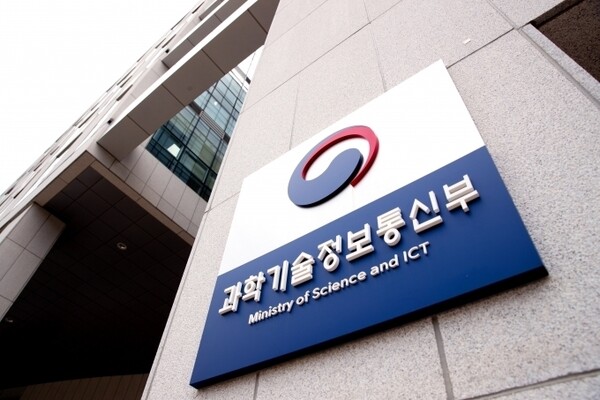
The Ministry of Science and ICT on Thursday held a hydrogen technology researchers meeting at the National Research Foundation of Korea's Daejeon office.
The meeting was arranged to share the status of hydrogen technology research projects and to discuss measures to secure 'NEXT hydrogen technology' to respond to the climate crisis and lead the future hydrogen market.
The ministry will invest a total of 42.7 billion won this year to strengthen full-cycle hydrogen technology self-reliance and competitiveness. Of that, it will put 25.1 billion won into the National Hydrogen Key Research Laboratory, a dedicated agency for hydrogen technology development, to build a performance verification system for commercialising core technologies such as alkaline and polymer electrolyte membrane (PEM) water electrolysis and to 추진 enterprise-linked joint demonstrations.
It will invest 17.6 billion won in securing promising future technologies, joint research with leading overseas countries and the development of full-cycle converged technologies covering hydrogen production, storage and utilisation, to accelerate the development of fundamental hydrogen technologies.
At the meeting, major research results to strengthen global competitiveness in hydrogen technology were presented. A team led by Jun-young Park (박준영), a professor at Sejong University, shared examples of developing low-cost, high-efficiency electrodes and catalysts for proton-conducting ceramic electrolysis cells (PCEC), which are drawing attention as next-generation water electrolysis technology.
Other hydrogen technology results were also presented, including high-efficiency hydrogen-producing strains and processes based on organic waste, ultra-porous high-performance hydrogen storage materials, and perovskite-based photoelectrochemical hydrogen production systems.
Researchers who attended stressed the importance of a 'technology bridge' so that fundamental technologies can lead to on-site industrial demonstrations. They also requested an expansion of long-term and stable research support for promising hydrogen technology fields.
The ministry plans to design a new project, HyBridge, to secure differentiated clean hydrogen supply sources beyond existing alkaline and PEM water electrolysis, including PCEC and photolysis and bio-hydrogen production, and to seek to secure a budget. The project will be 추진 at a total scale of 93.0 billion won from 2027 to 2034.
Dae-hyun Oh (오대현), director-general for future strategic technology policy at the ministry, said hydrogen is the key to achieving carbon neutrality and that it will support South Korea's hydrogen technology so it can achieve a global super-gap by reflecting voices from the research field.
 Jin-ho Lee
jhlee26@d-today.co.kr
Jin-ho Lee
jhlee26@d-today.co.kr