
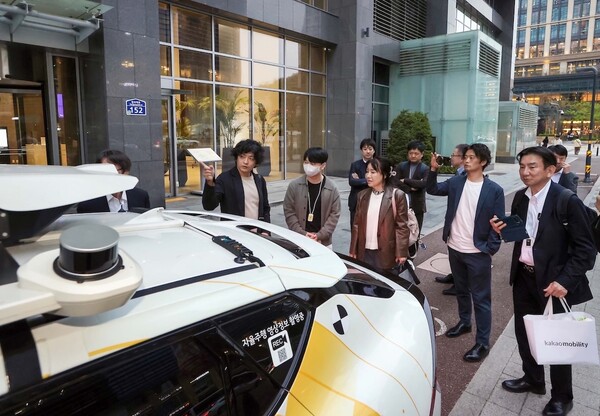
Kakao Mobility has shaken off years of legal risk after clearing suspicions of steering taxi calls and violating accounting standards. It is now expected to move beyond its platform business and shift in earnest into a physical artificial intelligence company centered on autonomous driving.
The Seoul Southern District Prosecutors' Office recently concluded there was no wrongdoing in two cases: a taxi dispatch system case filed by the Fair Trade Commission and an accounting standards violation case referred by financial authorities. Allegations in a call-blocking case remain, but the company has passed a major hurdle. Given that a court ruled in Kakao Mobility's favour in an administrative lawsuit in May last year over suspicions of steering calls, call blocking is also likely to produce an unremarkable result for the company.
With legal risk largely settled, Kakao Mobility can accelerate the business transformation it has already been pursuing. The core is expanding data and technological capabilities built from running a taxi platform into autonomous driving.
Kakao Mobility has been preparing to shift to physical AI. It has joined the industry ministry-led AI Future Car M.AX Alliance and is participating as an anchor company in its AI autonomous driving group. Its strategy is to secure a position from the development stage of a Korean end-to-end autonomous driving standard model optimised for domestic road conditions. End-to-end refers to a technology that integrates perception, decision and control into a single AI model to learn data and infer situations on its own, and it is emerging as the industry standard in autonomous driving.
Data accumulated through demonstration projects is a key asset. Kakao Mobility has operated autonomous driving services in Sejong starting in 2020 and in areas including Pangyo, Gangnam, Daegu, Jeju and Seoul, securing driving data of about 30,000 km.
The data was obtained through edge infrastructure such as LiDAR and camera sensors and self-operated autonomous vehicles. It consists of 150,000 cases across 10 types that can perceive and assess moving 3D dynamic objects such as people, vehicles and bicycles and 2D static objects such as traffic lights and signs. Mobility data accumulated through Kakao T and Kakao Navi, along with platform operating know-how such as dispatch, control and route generation, also supports the effort.
◆ Head of division and 3D object perception and end-to-end expert Kim Jin-kyu: "I will build a height of technology on a firm foundation of reality"
The company has also carried out an organisational overhaul. According to industry sources, Kakao Mobility this month created a Physical AI Division by integrating its existing Future Mobility Development Office and Future Business Office, and appointed Korea University computer science professor Kim Jin-kyu (김진규) as its head at vice president level. The move aims to bring together future mobility technology capabilities that were split between planning and development and to accelerate commercialisation of AI technologies that operate in physical environments such as autonomous driving.
In an internal personnel appointment message, Kim said, "I will build a height of technology on top of the solid 'foundation of reality' that Kakao Mobility has laid," showing his commitment to the shift into a technology company. He added, "Data that reads the flow of roads that changes by the minute every day, operational know-how that has solved complex real-world problems, and service operating capabilities that have put customer safety first: these three are Kakao Mobility's unique assets that even global big tech companies cannot easily imitate," he said.
Kim, head of Kakao Mobility's Physical AI Division, received bachelor's and master's degrees in electrical and electronic engineering from Korea University and a doctorate in computer science from the University of California, Berkeley. He later participated in key end-to-end autonomous driving projects at Waymo and is an autonomous driving expert. He currently leads the Vision & AI Lab at Korea University, conducting core research including multimodal representation learning, machine learning for large-scale autonomous driving, continual and lifelong learning, foundation models and generative AI.
The Vision & AI Lab's research direction directly connects to Kakao Mobility's business. The lab is developing algorithms and real-time processing and efficiency improvement technologies to solve key perception problems in autonomous driving, such as 3D object detection, behavior prediction and occupancy prediction. In particular, recent research results such as ORA3D, which improves 3D object detection accuracy in overlapping areas from multi-view cameras, a technology that streamlines 3D occupancy prediction with low-resolution queries, and the pedestrian trajectory prediction model GUIDE-CoT are directly linked to Kakao Mobility's accumulated 3D dynamic object datasets.
Domain generalisation research for commercialising autonomous driving is also worth noting. Domain generalisation refers to technology that allows AI trained in one environment to maintain performance in different environments. For example, it would allow autonomous driving AI trained in downtown Seoul on a clear day to operate accurately on a rainy day on a coastal road in Jeju.
The Vision & AI Lab is conducting research to build AI systems that overcome domain shift problems and respond to environmental changes through self-supervised learning, contrastive learning and curriculum learning. This is also a challenge faced by Kakao Mobility, which has carried out demonstrations across diverse city environments such as Sejong, Pangyo, Gangnam, Daegu, Jeju and Seoul. The lab is also conducting research on real-road responses, including explainable autonomous driving AI that internalises human advice and explanations, and simulation-based scenario verification.
Multimodal AI capabilities also form the basis for expanding the physical AI business. The Vision & AI Lab is developing technologies that comprehensively understand and use various data modalities such as images, text and sound. This is also linked to Kakao Mobility's 3D rendering technology under development. The technology, like Google's Immersive View, lets users freely look around a space from a desired viewpoint, and it is currently being tested in various environments including office interiors, objects and parking lots. The Vision & AI Lab has also collaborated with companies and research institutions such as Waymo and Hyundai Motor.
A Kakao Mobility official said, "Through establishing the Physical AI Division and recruiting core AI talent, we want to secure technological competitiveness at a level that can compete with global companies and accelerate the commercialisation of future mobility technologies." The official added, "In particular, Kim Jin-kyu, the newly recruited head of the Physical AI Division, is an industry-academia integrated expert who combines practical experience at global companies such as Waymo with academic expertise, and he plans to focus on securing competitiveness in autonomous driving and physical AI." The official said, "We also plan to continue both in-house technology development and close cooperation with the industry to focus on building a safe autonomous driving ecosystem," the official added.
 Daegeon Seok
d2dg@d-today.co.kr
Daegeon Seok
d2dg@d-today.co.kr