
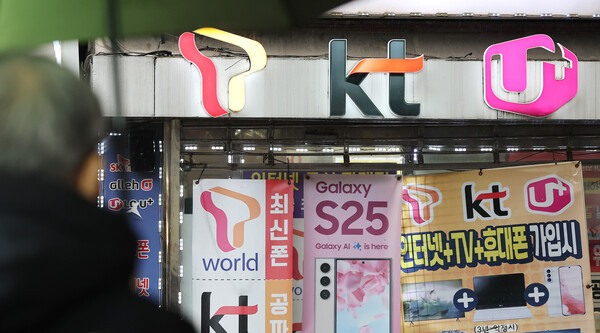
[DigitalToday reporter Jin-ho Lee] KT's decision to waive early termination fees for all customers is expected to change South Korea's mobile telecoms market in the New Year. Some forecasts say competition for number porting could heat up again, while others caution it may amount only to short-term volatility.
KT said on Dec. 30 it will waive early termination fees until Jan. 13 for customers who want to cancel mobile service contracts, saying it feels responsible for an unauthorised small-payment hacking incident. The decision came a day after the Ministry of Science and ICT acknowledged KT's fault and demanded a fee waiver for all customers. The waiver will also be applied retroactively to customers who had already terminated contracts after Sept. 1.
The industry is watching the possibility that the number-porting market could be shaken for some time by the move. Early termination fees are seen as the biggest barrier to switching carriers. For KT customers, it creates conditions to compare benefits offered by other carriers without 부담. An industry official said, "The fee waiver is a symbolic step that stimulates market sentiment," adding, "Regardless of the actual scale of switching, competitors cannot help but pay attention."
The beginning of the year is also a period when carriers use marketing resources relatively aggressively. With subsidy restrictions effectively gone after the abolition of the handset subsidy law, KT could see a short-term increase in subscriber outflows if LG Uplus and SK Telecom step up offensives such as expanding support payments.
KT is rolling out a "customer reward program" alongside the fee waiver, including an additional 100GB of data, roaming benefits and content vouchers. Unlike SK Telecom, which experienced a USIM hacking incident, it did not offer fare discounts. The industry is focusing on that as a factor that could expand switching. An industry official said, "Wasn't there no noticeable carrot like a fee discount?" adding, "For younger generations who have little resistance to switching, this could be an opportunity."
Users of unlimited data plans are particularly more likely to switch. The share of unlimited-plan users among KT's wireless subscribers is known to be about 30 percent. For them, the additional data offer is unlikely to be a meaningful incentive. With a higher share of younger users among unlimited-plan subscribers, the psychological barrier to switching is also relatively lower.
There are variables. The number-porting market has recently been on a downtrend. According to the Korea Telecommunications Operators Association (KTOA), the number of porting cases peaked at about 950,000 in July, then fell for four straight months to 640,000 in August, 640,000 in September, 600,000 in October and 550,000 in November. Customer churn was not large even though hacking incidents at SK Telecom in the first half, then at KT in August and LG Uplus in October were disclosed in succession. The market is detecting a mood that views the utility of switching itself as low amid a perception that "you cannot feel safe wherever you go."
Meanwhile, there is also a view that KT's compensation plan this time minimised the company's losses. Some interpret it as an unavoidable choice from a management perspective. Fee discounts directly hit average revenue per user (ARPU). SK Telecom's operating profit fell sharply in the third quarter due to the impact of a compensation plan that included fee discounts. For KT, which is set to appoint its next CEO, defending earnings and its share price is an important task.
An industry official said, "A tug-of-war among carriers could take place from the New Year," adding, "January will be an opportunity to gauge marketing competition and market sentiment among carriers in 2026."
 Jin-ho Lee
jhlee26@d-today.co.kr
Jin-ho Lee
jhlee26@d-today.co.kr