
[Houston, United States = Digital Today reporter Chi-gyu Hwang] Moves in related industries are accelerating to use AI in manufacturing site processes spanning design to production. Some also say AI is changing the DNA of manufacturing itself.
Dassault Systemes, a maker of manufacturing software, says the shift used to be limited to converting paper-based manual processes into digital form. It now points to a trend toward a “platform-centric structure” in which AI-based data is shared in real time across multiple departments and systems and used directly for decision-making.
It also gave significant attention to manufacturing in the AI era at its annual 3DEXPERIENCE World 2026 conference held in Houston from Feb. 1 to 4 local time.
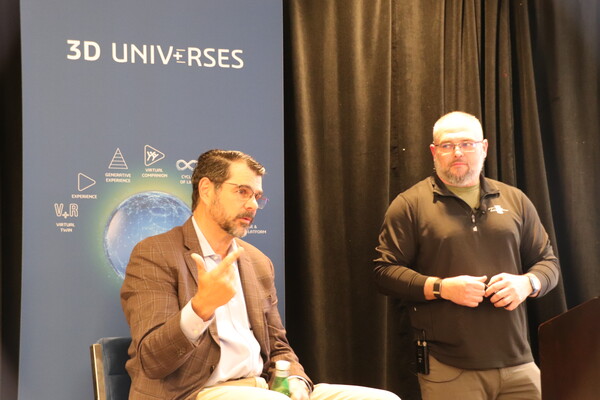
Devin Malone (데빈 말론), head of Dassault Systemes' DELMIAWorks unit, and Mike Buchli (마이크 부츠리), a Dassault Systemes SOLIDWORKS manager, held a media briefing at 3DEXPERIENCE World 2026 and shared key issues, including how AI is changing manufacturing. DELMIAWorks is a MES (Manufacturing Execution System) solution that manages production sites, and 3DEXPERIENCE Works is a cloud-based 3D design platform.
The company says consumers now order products with a single click and also want faster delivery, but it is not easy for companies to meet those demands. It says they are still held back by complex realities such as manufacturing processes, supply chains and labor shortages. Consumers are increasingly looking for appealing new products, but producers find it difficult to respond without sophisticated and advanced systems to support them.
Malone and Buchli stressed that AI can help manufacturing companies solve problems they face in a complex environment.
They said AI can first play a role in easing imbalances between design and production. In the past, the biggest bottleneck in developing a new product was design speed, but the situation has changed. As design tools such as SOLIDWORKS have advanced, design has sped up, and production is now struggling to keep up with design.
Malone and Buchli stressed, “Labor shortages, the departure of skilled workers, and supply chain problems have now become factors that block manufacturing itself. How to ‘intellectualize’ production sites is emerging as a key element of corporate competitiveness.”
They presented data integration and use as one of the solutions. Put more simply, it means going beyond merely storing documents and building a 'single source of truth' in which ERP (enterprise resource planning) systems, CAD, PDFs and on-site sensor data are integrated into one.
They said this can break down the biggest barrier between design and manufacturing. If the existing process was to pass blueprints from the design department to manufacturing, they said strengthening interconnectivity between design and manufacturing will become an important competitive edge.
Malone and Buchli stressed, “Manufacturers often oversupply parts to address potential problems, but if they have deep insight into systems or manufacturing processes, there is no need to do that. If manufacturing properly uses design intent, it can secure predictability.”
They also stressed the role of Aura, a virtual companion AI solution provided by Dassault Systemes. Aura is a platform well suited to collective knowledge and ensures everyone has accurate information based on the right standards.
AI is expanding its role beyond production automation to serve as a ‘decision-making assistant’ as well. For example, AI analyzes part shapes to judge machinability and recommends the most suitable cutting method or tools. It presents the fastest and most cost-effective scenario among dozens of machining methods to help workers choose. They said this not only reduces repetitive tasks but also improves overall process quality and predictability.
They said AI can automate process planning and tooling scheduling, prevent oversupplying parts or delivery delays, and reduce information disconnects between design and production. Malone and Buchli said, “These changes can enable small and medium-sized manufacturers to run production and operations as precisely as large companies, so they can play a decisive role in securing competitiveness.”
 Chi-gyu Hwang
delight@d-today.co.kr
Chi-gyu Hwang
delight@d-today.co.kr