
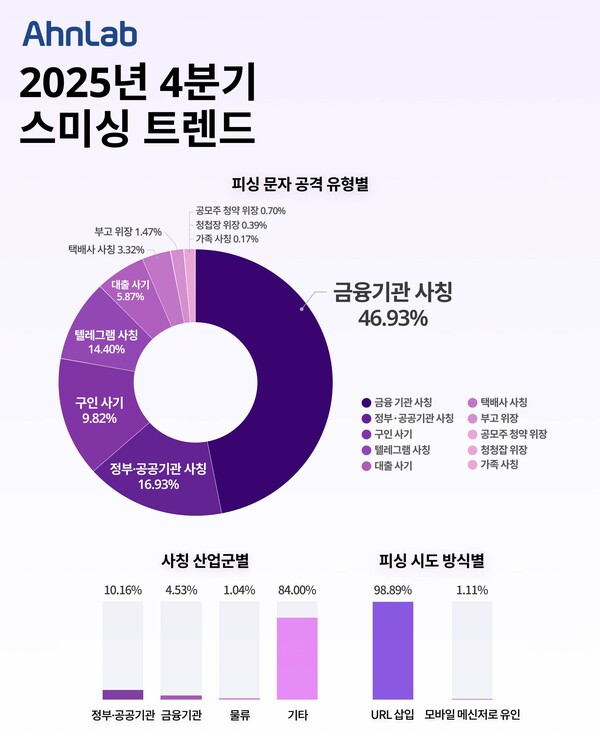
AhnLab said on Wednesday it released its "Q4 2025 phishing text message trends report," which analyzed phishing texts it detected from October to December using its agentic artificial intelligence (AI)-based security platform, "AhnLab AI Plus (AI PLUS)."
Among types of phishing text attacks that occurred in the fourth quarter of last year, financial institution impersonation was the most common at 46.93 percent. This type rose 343.6 percent from the previous quarter. It was followed by impersonation of government and public agencies at 16.93 percent, job scam at 14.40 percent, Telegram impersonation at 9.82 percent and loan scam at 5.87 percent.
Financial institution impersonation mainly used messages such as "card issuance completed" or "transaction details alert." The method induces users to click a phishing site URL or connect to a fake customer service call by telling them to report it if it was not something they applied for.
By share of industries impersonated by attackers, government and public agencies ranked first at 10.16 percent. They were followed by financial institutions at 4.53 percent, logistics at 1.04 percent and others at 84.24 percent.
Impersonation of other industries accounted for more than 80 percent of the total. This is seen as the result of an increase in "scenario-masquerading" attacks that fake common situations rather than naming a specific institution. Financial institution impersonation often used only financial keywords without mentioning a specific bank name, leaving it second in industry-by-industry statistics.
As a method of luring victims, URL insertion accounted for 98.89 percent. A method that draws users to mobile messengers accounted for 1.11 percent.
To prevent damage, AhnLab stressed that users should follow security rules including not clicking URLs sent by unclear senders, checking the reputation of suspicious phone numbers, blocking international-origin texts and installing smartphone security products.
AhnLab said, "Phishing text attacks use highly attention-grabbing issues such as money and job searches, as well as everyday topics, so a pattern similar to last year could continue this year." It added, "Ahead of the Lunar New Year holiday, people should share the tactics with family and acquaintances to raise awareness."
 Seulgi Son
sageson@d-today.co.kr
Seulgi Son
sageson@d-today.co.kr