
Dassault Systemes, a manufacturing software company, is accelerating an expansion of its generative AI services aimed at design professionals. After unveiling its first virtual companion, Aura, last year, it has now also released preview versions of Leo and Marie, virtual companions that can carry out higher-level engineering work. Official versions of Leo and Marie are scheduled for release in the first half.
The company says Aura specialises in finding and exploring ideas. It connects internal data with external knowledge on the web to help users flesh out design ideas. Leo is an engineering AI that reviews manufacturability and design feasibility and proposes designs suited to actual production. Marie focuses on science-based analysis and covers high-difficulty areas such as drop tests, ergonomic evaluations and responses to medical device regulations.
Dassault Systemes says Aura, Leo and Marie, as AI agents, will each take on a role and significantly raise efficiency in engineering design work.
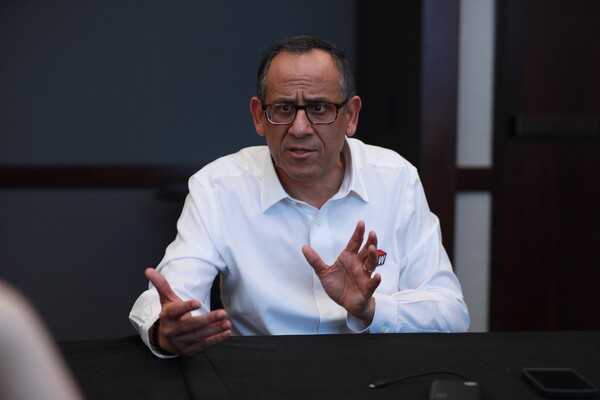
At Dassault Systemes' annual conference, 3DEXPERIENCE World 2026, DigitalToday spoke with Suchit Jain (수칫 제인), vice president for 3DEXPERIENCE Works strategy and business development at Dassault Systemes, about how AI will change design.
-Dassault Systemes stresses that its virtual companions differ from typical large language model (LLM)-based AI. What did you focus on in developing Aura, Leo and Marie? "Aura, Leo and Marie are based on RAG (Retrieval-Augmented Generation) technology, which makes it possible to find physics and internal data. If a company has internal knowledge and know-how, it can use AI to find and use needed information without leaking it outside. We are also building an environment to safely call appropriate tools through MCP (Model Context Protocol)."
"These agents are all called depending on different work contexts. They also include agentic AI elements, including autonomous collaboration among agents. Agentic AI is the concept that, when given a specific task, AI finds a solution on its own without being provided with a preplanned method. Dassault Systemes is moving in that direction."
If multiple agents operate in tandem, there could be a possibility of errors or conflicts.
"We provide multiple agents because not every problem can be solved as one. Someone who needs to solve a business problem, an engineering simulation specialist, and a researcher who needs discoveries at the level of a molecular scientist should not use the same agent. Required computing resources and work context also differ depending on the task. We introduced three agents in consideration of computing resources and costs. Dassault Systemes virtual companions can also cooperate among agents depending on the task being performed. Because the agents are based on a single platform, we think we can see whether agents are collaborating and can resolve conflict issues."
Do users choose and call Aura, Leo and Marie as needed, or does the system automatically connect a companion suited to what the user enters?
"We plan to let users choose to fit their needs. Leaving it to the model could cost more."
What is the pricing policy for the virtual companions?
"The related business model is still under review. But there will be a free tier included in existing subscriptions. For SolidWorks, the current licence includes a platform-based service called 'cloud services'. Aura will be included in cloud services, and we think other companions will be charged separately in consideration of the costs of using Nvidia GPUs."
At this year's conference, Dassault Systemes' generative AI-based design strategy became more concrete than before. What impact do you expect it to have on users?
"If you look at a demo where Leo creates a model in 5 minutes and completes a simulation, you might feel fear about job replacement. But Dassault Systemes has long talked about not excluding design and instead making it more widespread than now. The priority is not for AI to replace the work of design itself, but to support designers in strengthening their capabilities with AI.
In a virtual companion scenario, jobs for analysts or designers will not disappear. It raises productivity for both designers and analysts. Dassault Systemes' philosophy is that technology plays a co-pilot role and helps people do more work. Some aspects of design may change in the future, but more jobs will be created."
How should students learning design respond to changes driven by AI?
"Doing 3D modelling with AI is not simply at the level of, 'Design something like this.' Of course you can do that, but it is not the ultimate solution. It is hard to get a perfect design that way. Detailed elements are still needed at the engineering stage. Even if you explain things in your own way, a fully functional model may not come out. That is why we stress that virtual companions do not replace work, but only raise productivity.
Even if AI technology advances, it cannot replace engineering education itself. Even in the AI era, you need fundamental engineering knowledge to do the job properly. Even if AI makes work easier, it is still important to understand, observe and ask the right questions. That requires know-how. The same applies to students who dream of becoming engineers. Foundational physics and science will still be needed, and students should continue to be taught."
In the AI era, how do you see South Korea's manufacturing industry?
"South Korea is already ahead in many areas, including manufacturing. It seems to use AI well, too. If there are states of not knowing at all, knowing but not using much, and knowing and using a lot, I think South Korea is on the side of using a lot now. Many South Korean startups also participate in the startup programme run by Dassault Systemes."
 Chi-gyu Hwang
delight@d-today.co.kr
Chi-gyu Hwang
delight@d-today.co.kr