
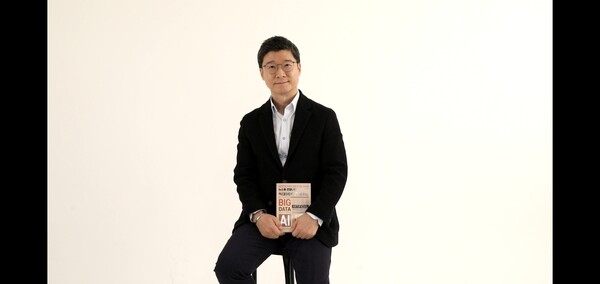
[Dong-cheol Kim (김동철), professor in the Department of AI Applications at Hansung University] Data is called a mine of the future, but beyond personal information, guides for data are not standardised and there is no authoritative assessment of quality. Big data used by artificial intelligence for training covers all accessible data. If AI learns from inaccurate data, its intellectual level also declines. Data also has vitality and a lifecycle.
Data also needs continuous updates as its lifecycle progresses. For example, if a restaurant does not post a changed break time on its website, someone who receives that restaurant’s information through AI and makes a reservation for that time could end up making a wasted trip. This is not an AI problem but a data problem. Many issues known so far as AI problems may, on closer look, be data problems. Just as what people eat must be safe food, the data AI uses for machine learning must also be safe.
In South Korea, amendments to the Personal Information Protection Act, the Information and Communications Network Act and the Credit Information Act, known as the three data laws, took effect in August 2020. They allow data processed under a pseudonym or anonymised so that individuals cannot be identified to be provided externally or used. This is a legal constraint on data trading and also a safeguard. If the aim is to provide AI with abundant high-quality big data, everyone involved with data must care about its quality. A case in which AI trained on foreigners’ disease data produced disappointing results in South Korea is also an example of data quality.
The mydata initiative that began in 2022 says data sovereignty lies with individuals, and responsibility and management should therefore also be handled by individuals. As every individual comes to recognise data, valuable data collected in this way can hold significant value even if personal information is de-identified. A company that provides university admissions consulting has all information on university admissions and gives fee-based advice to students. It builds a model of admission guideline benchmarks based on past admissions data and the admissions policy the government is currently pursuing. This is the moment data turns into information and knowledge and adds value. In such cases, data can be recognised as an asset and can be classified in financial statements as tangible assets, intangible assets or other assets, and may be subject to depreciation. Within the scope allowed by law, the company can also sell data usage rights in the market.
In the AI era, all information has utilisation value. But if data is seen as something to buy and sell, circumstances can change. If data can improve AI performance, providers of AI may be willing to pay a large cost even for a small amount of data. That is because AI companies such as Microsoft, Google and Meta are investing huge sums in labelling, known as “sticking eyes on AI dolls”. On the other hand, they must also be able to convey the value of ordinary data.
With raw data alone, it is difficult for a third party to easily judge what value it has. To do a project with data, there is substantial pre-processing work required before actual analysis and interpretation. Therefore, data that is traded must be perfectly pre-processed, and metadata describing the data must also be provided without shortage. Best-practice examples of added value that can be created from such data should also be provided. The principle is that value rises as data is transformed and delivered as information, knowledge and then insight.
According to “The current status and future outlook of South Korea’s data industry, global trends,” published in 2025 by the Korea Data Industry Association, South Korea’s data trading volume is more than 30 trillion won and is growing 12.7 percent each year. Compared with the surge in the amount of data produced so far, data trading that has only now begun is also highly likely to surge. To prepare for this, the government has begun training data brokers at a level equivalent to professional engineers and has produced more than 1,000 brokers so far. The time is approaching when every institution or company will hire or retain data brokers. Data and AI are establishing themselves as core capabilities of companies and countries. I hope the data trading ecosystem now being built becomes a case the world follows.
 Dong-cheol Kim
delight@d-today.co.kr
Dong-cheol Kim
delight@d-today.co.kr