
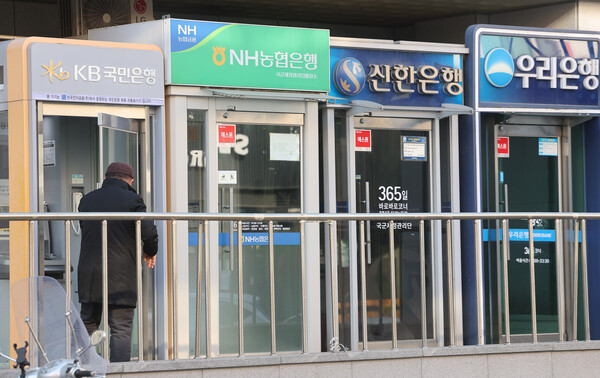
South Korea's financial authorities will significantly strengthen procedures for bank branch closures and expand disadvantages tied to closures through regional financial access assessments. Consolidations or mergers of branches within a 1 km radius will also be included in prior impact reviews without exception. The authorities also decided to pilot the introduction of bank agency services using post offices and other outlets.
The Financial Services Commission on Tuesday held a meeting with financial field messengers at the Government Complex Seoul and announced policy directions for financial consumer protection along with measures to address bank branch closures.
The FSC decided to significantly strengthen procedures so banks fully reflect consumer convenience, not just profitability, when deciding on branch closures. Consolidations of branches within a 1 km radius had been excluded from the joint procedure, but going forward all such moves will go through prior impact reviews and local opinion gathering, except for cases such as relocations within the same building where there is no substantive movement.
The prior impact review will also be systematised from a formal operation into a structure of "status analysis-impact diagnosis-alternative decision" and the assessment items will be subdivided from 4 to 8.
New objective standards will also be introduced for areas with a high impact from branch closures. If the distance to a nearby branch exceeds 10 km or dependence on in-person services is higher than average, authorities will judge there is a high risk of undermining financial access and will prioritise maintaining the branch or applying strengthened alternatives.
External evaluators will also take part in post-impact reviews to recheck the adequacy of alternative measures.
BRANCH CLOSURE DISCLOSURE TO BE EXPANDED, PENALTIES TO BE STRENGTHENED FOR NON-METROPOLITAN CLOSURES
Transparency in the branch closure process will also be improved. The Korea Federation of Banks will revamp its consumer portal to disclose key details from prior impact reviews and the locations of alternatives to closed branches, and add a function to search for branches by region.
In a regional reinvestment assessment, deductions will be increased when banks close branches outside major metropolitan cities. As the assessment is used for selecting local government treasury managers, it is expected to serve as a practical incentive for banks to maintain local branches.
Indicators related to maintaining and opening branches will also be added to an assessment of consumer protection practices to reflect efforts to improve financial access. The Financial Supervisory Service plans to regularly inspect each bank's branch operations and the results of prior impact reviews.
EXPANSION OF MOBILE BRANCHES, PILOT INTRODUCTION OF BANK AGENCY SERVICES
Alternative measures to prevent gaps in in-person financial services will also be strengthened. Digital branches will be recognised as an alternative to a closed branch only when at least 1 support staff member is assigned, to minimise inconvenience for older users. In non-urban areas, banks will expand regular visits by mobile branches and increase operations centred on locations with high demand such as welfare centres and community service centres.
Bank agency services using the post office network will also be piloted during 2026 in the form of an innovative financial service, followed by a push to institutionalise it.
With open banking and MyData services now available through in-person channels as well, banks will actively guide customers during the advance notice process on how to use branches of other banks. They also plan to expand the installation of shared ATMs, centred on traditional markets and other locations.
The FSC said it will fully implement the measures from March 2026 and manage the process so financial consumers' access and convenience are not harmed during bank restructuring.
OFFICIALS SAY INCONVENIENCE TO FINANCIAL CONSUMERS SHOULD BE MINIMISED
Among the participants, Si-yeon Lee (이시연), a researcher at the Korea Institute of Finance, said expanded bank branch closures are a global trend. But she said it is important to secure alternatives that can maintain the quality of financial services available to digitally vulnerable groups, and to establish institutional supplements that can also provide banks with appropriate strategic incentives.
So-hyun Joo (주소현), a professor in Ewha Womans University's department of consumer studies, stressed that the banking sector should view branches from a medium- to long-term perspective. She said banks should consider branches as contact points where they face financial consumers directly, rather than thinking of them simply in terms of profitability and costs, and should take into account improvements in convenience and building trust.
Kyung-min Kim (김경민), a managing director at the Korea Federation of Banks, said the banking sector will faithfully implement the improvements in branch closure procedures discussed on Tuesday and also work to establish management practices that take financial consumer convenience into account.
 Ji-young Lee
ljy@d-today.co.kr
Ji-young Lee
ljy@d-today.co.kr