
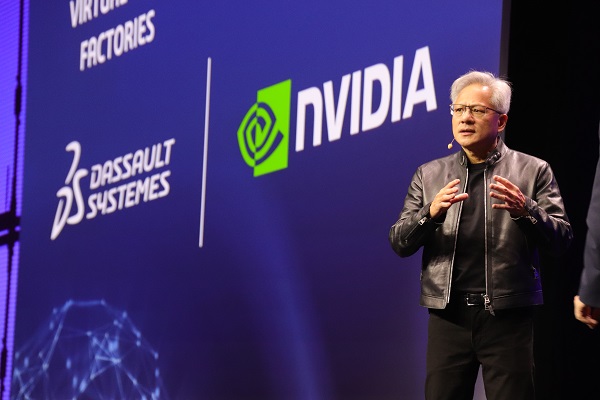
"I do not see (because of AI) fewer designers, or fewer software tools being used than before. What I am very likely and certain will happen is that every future designer, every SolidWorks user, will have a companion team,"
Nvidia CEO Jensen Huang (젠슨 황) presented AI and designers working as a team as the most likely scenario for change that AI will bring to product design. He stressed that the first question is not whether AI will replace designers, but how to work with AI companions.
In a keynote speech at Dassault Systemes' annual 3DEXPERIENCE World 2026 conference in Houston on Feb. 3 local time, he said, "AI agents will be our companions, and we will be AI agent managers and creators. As we have many agents or companions perform various tasks, an opportunity will open to recreate how we think about design and creativity. I think this will be a completely revolutionary change for everyone." He added, "In this situation, the use of software tools will increase significantly, and that will be a big benefit for the software industry as well."
Dassault Systemes and Nvidia also announced cooperation at the 3DEXPERIENCE World 2026 venue centered on building a physical AI platform.
Under the cooperation, Dassault Systemes' virtual twin technology that digitises real objects will be integrated with Nvidia's computing platform, AI models and CUDA-X software libraries. Dassault Systemes said this can support a range of applications across biology, materials science, engineering and manufacturing, and an AI-based "virtual companion" embedded in Dassault Systemes' 3DEXPERIENCE platform.
Nvidia CEO Jensen Huang and Dassault Systemes CEO Pascal Daloz (파스칼 달로즈) also appeared together on the keynote stage to share views on changes AI will bring to design work. In the process, AI companions and people working together was presented as an almost certain scenario for the future of design work.
Huang said this scenario is not just talk. It rests on a technical situation. The key is that AI has made conversions between structured and unstructured data very easy.
Huang said, "Unstructured data is photos, audio files and video, and we want to represent these as structured data. To convert a 2D image into a 3D model, and then into 3D data, we need AI." He said, "Once it is converted into 3D data, that information becomes controllable and interchangeable. It can be continually strengthened and improved, and is stored in a structured database. The reverse is also true. Converting structured data into unstructured data is also easy. We can reinforce the design process using agents and AI."
The process of converting back and forth between structured and unstructured data may require revisions in some parts, and it also requires training AI companions and having them work together. All of that is work that needs people.
Huang said that as scenes of working with companions increase in design, software-defined environments will ultimately spread as well. Software-defined refers to controlling or implementing hardware functions through software, and it can be applied across various fields including data centres and cars.
Huang said, "In the future, everything, from design and representation to simulation and even operations, will be software-defined. Starting with a pair of sneakers, cars and robots will also be based on software-defined. Factories that assemble cars and robots will, too."
That means a process of first implementing something in a virtual twin, examining it in various ways, and applying it to the real world if there are no problems, will expand beyond individual products to the factories that make products. He said, "What we are experiencing because of AI is a new industrial revolution. Just as energy, mechanical power, electricity and the internet did, AI is also a fundamental technology that affects productivity across many industries."
Physical AI, or the world model, which Dassault Systemes and Nvidia are cooperating on is different from AI based on large language models typified by ChatGPT. Huang said physical AI must follow the laws of physics rather than preferences or values. It must also understand causality. It must know that when one domino is knocked down, all other dominoes that are connected or nearby also fall. It must understand inertia and friction, gravity and contact. Huang said, "When we design things, we have to teach AI senses that are not necessarily captured in language. To do that, we have to teach it the laws of physics with many examples."
 Chi-gyu Hwang
delight@d-today.co.kr
Chi-gyu Hwang
delight@d-today.co.kr