
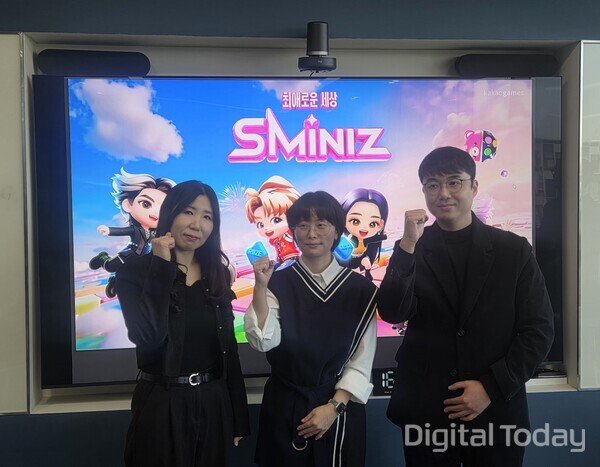
Kakao Games says it is opening a new frontier in digital fan activity with SMiniz, a mobile match-3 puzzle game that uses intellectual property from SM Entertainment.
Developer Metabora said at a briefing on Feb. 2 that it went beyond a simple licensing tie-up and persistently built into the game the fine points of attachment fans feel toward their favourite artists. It described this as an attempt to move the behaviour and emotional structure of fandom into a game system, rather than simply consuming idol IP.
Metabora said it has focused on bringing idol fandom culture into the game, drawing on its experience making casual titles such as Friends Tower, Pixar Tower, Everytown and I Love Coffee. Production division head Kim So-hee (김소희) said that while existing idol games focused on creative gameplay or making artists look pretty, SMiniz differentiates itself by using the most mainstream gameplay and implementing digital fan culture such as collecting, decorating and showing off.
It said it analysed fan sites and fancam videos during the character design process and turned individual artists’ physical traits into data. Planning lead Kim Yong-hwa (김용화) said it found and reflected details such as how many centimetres from the eye a beauty mark sits, eyebrow angles, ear shapes and even small scars. He said it also made animation movements such as rejoicing or greeting different for each member to match their personalities. The development team added that such details are key to getting fans to see characters not as “models in a game” but as “the artist I know.”
The game’s structure follows offline fandom culture. When users play match-3 puzzles to obtain photo cards, they receive a pair consisting of a live-action image and an illustration. Users can freely decorate acquired cards through “top loader decoration,” and the game also includes a dedicated cafe and mirror-selfie templates reflecting the “etiquette shot” culture of placing photo cards alongside food photos.
Producer Park Il-woong (박일웅) said it focused on implementing in the game a virtuous cycle of fandom culture in which fans play puzzles to obtain photo cards, then show them off and communicate. It said the structure creates a clear motivation to repeat puzzle play and is designed to keep users from leaving even after collecting.
Results from a closed beta test conducted in December were positive. Park said key indicators such as retention and stage completion rates were relatively high compared with typical puzzle-game metrics, adding that qualitative evaluations of the photo-card meta were also strong. He said internal sentiment was encouraged as the score for willingness to play in an actual service also came out high.
On operations, it said it configured all members equally to prevent the focus from tilting toward a specific group or popular members. Kim said it applied a personalisation system under which, when users choose a group and favourite on entry, that member is displayed most prominently. He said users can change their favourite for free at any time after finishing the tutorial.
The revenue model separates puzzle currency from fan-activity currency to reduce the burden on users. Kim said puzzles can be enjoyed sufficiently through play, while only users who want to focus on decorating photo cards buy items such as stickers or frames with separate currency. Park added that it provides buff systems such as team block skills for fans with little game experience and designed item acquisition to be ample.
If an issue arises involving an artist, it plans to respond by putting fans’ feelings first, including adjusting exposure systemically through close consultations with SM. Kim So-hee said that when such a situation unavoidably occurs, system responses matter, but it is important to update quickly by reflecting what fans think.
It said the gameplay is tailored to the pace of the “Shorts” generation. Kim said if typical games are long-form, SMiniz preserves the feel of blocks bursting at a fast tempo like short-form. Depending on the character users select, the shapes of certain blocks change. It introduced a cooperative system in which collecting those blocks allows the character to resolve puzzle missions through skills.
Kakao Games said it is reviewing various possibilities, including linking to concert tickets or offline goods, following a campaign tied to the “SMTOWN Fukuoka Concert” held on Jan. 31. SMiniz supports a total of six groups: NCT 127, NCT Dream, WayV, Riize, NCT Wish and aespa. It aims for a global release in the first quarter of this year.
Park said it plans to expand the groups through future updates after stabilising the service following its opening.
 Lee Ho-jung
lhj@d-today.co.kr
Lee Ho-jung
lhj@d-today.co.kr