
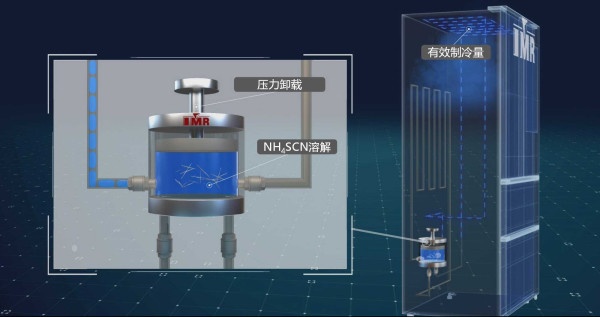
A group of Chinese researchers, including the Institute of Metal Research (IMR) of the Chinese Academy of Sciences, has discovered a new cooling principle that could overcome the limits of existing refrigerant technology. The team used an aqueous solution of water and ammonium thiocyanate (NH4SCN) to implement a cooling mechanism with both high efficiency and environmental friendliness. It named the principle the Dissolution Barocaloric Effect.
On Feb. 2 local time, online media outlet Gigazine reported that the research was conducted by a joint team from IMR, the Beijing Center for High Pressure Science and Technology Advanced Research and Xi'an Jiaotong University, and that the results were published in the international journal Nature. The principle rapidly absorbs and releases large amounts of heat by using dissolution and precipitation reactions of salt as pressure is applied or removed.
The material used by the team was an aqueous ammonium thiocyanate solution. When pressure is applied to the solution, the salt precipitates and releases heat. When pressure is reduced, the salt dissolves quickly and absorbs heat from its surroundings. The key point is that this process produces large temperature changes in an extremely short time.
In experiments conducted at room temperature, the solution's temperature was confirmed to drop sharply by about 20 to 30 degrees within 20 seconds. In a higher-temperature environment, cooling performance improved to a maximum of more than 50 degrees. This is assessed as far exceeding the temperature drop achieved by solid caloric materials studied previously.
According to the researchers, the cooling system operates in a four-stage cycle: a heating stage through pressurisation, an external heat dissipation stage, a cooling stage through depressurisation, and a cooling-capacity transfer stage. It can absorb up to 67 joules of heat per cycle. Its theoretical energy efficiency is about 77 percent, showing far higher efficiency than existing vapour-compression refrigeration technology.
With refrigeration technology essential in modern society, global refrigeration and cooling still depend heavily on vapour-compression refrigeration that has been used since the 19th century. That method consumes massive electricity as refrigerant gas is compressed and vaporised, and it also involves greenhouse gas emissions. In China, refrigeration-related industries account for about 2 percent of gross domestic product, but the burden is large enough that they account for 20 percent of total electricity consumption and 7.8 percent of carbon dioxide emissions.
Solid-state transition cooling technologies have been seen as an alternative to address these problems, but limits in thermal conductivity have constrained large-scale, high-output applications. The researchers expect the Dissolution Barocaloric Effect discovered this time to be able to solve three challenges at once: low carbon emissions, large-capacity cooling and high heat-exchange efficiency.
The research was supported by the National Natural Science Foundation of China and a key research project on frontier science of the Chinese Academy of Sciences, and it also used experimental support from Japan's synchrotron radiation accelerator facility SPring-8. The researchers are reviewing the potential to expand into various fields, including data centre cooling, artificial intelligence (AI) computing equipment and industrial refrigeration systems.
 Jinju Hong
hongjj@d-today.co.kr
Jinju Hong
hongjj@d-today.co.kr