
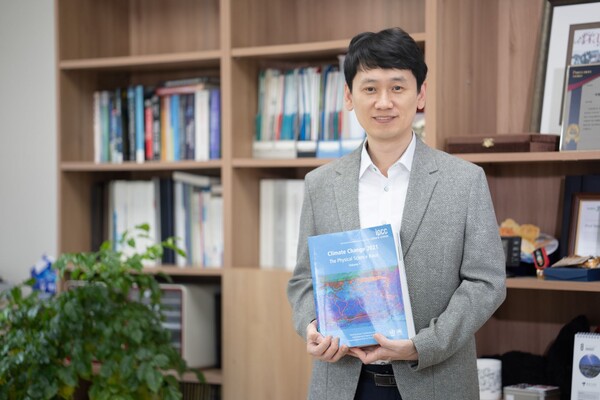
South Korea's Ministry of Science and ICT and the National Research Foundation of Korea said on Feb. 4 they selected Min Seung-gi (민승기), a professor in the Department of Environmental Engineering at Pohang University of Science and Technology (POSTECH), as the February recipient of the Korea Science and Technology Award.
The ministry and the foundation selected Min in February, which includes Polar Bear Day to reflect on the impact of global warming on wildlife and polar ecosystems. They cited his work in presenting scientific evidence for responding to the climate crisis.
As concerns grow that Arctic sea ice could disappear in the 2050s, existing climate models have had limitations. They estimated smaller reductions in sea ice than observed data and could not isolate and verify the effects of forcings other than greenhouse gases.
Min applied a future-projection correction technique based on greenhouse gas radiative forcing to Arctic sea ice research to overcome those limitations. Greenhouse gas radiative forcing refers to the net impact of rising greenhouse gas concentrations on Earth's radiative energy balance.
Using 41 years of satellite observations and climate model experiment data, Min separated and analysed the effects of greenhouse gases, aerosols and natural forcing through a multiple linear regression technique.
The analysis found Arctic sea ice declined significantly in every month of the year and clearly confirmed that the main cause of the decline was an increase in greenhouse gases. He then compared the magnitude of the greenhouse gas effect detected in observations with climate models and reflected the gap in future projections for the disappearance of Arctic sea ice.
The corrected projections showed the timing of Arctic sea ice disappearance could be brought forward by more than 10 years from existing forecasts, possibly as early as the 2030s. He also presented for the first time that Arctic sea ice could completely disappear in the 2050s even under a low-emissions greenhouse gas scenario where sea ice had been expected to remain.
Min is a lead author of the Intergovernmental Panel on Climate Change (IPCC) Sixth Assessment Report and a member of the International Detection and Attribution Group (IDAG), a group of experts that identifies the causes of climate change. He has studied how Arctic warming affects the global climate system and extreme weather with support from the ministry's mid-career researcher support programme. The results were published in the international journal Nature Communications in June 2023.
Min said, "We must seriously consider that the pace of global warming is faster than expected and extreme weather phenomena could become more severe." He added, "As a climate scientist, I will steadily expand the role of science so that we can thoroughly prepare for the climate crisis."
The Korea Science and Technology Award selects 1 researcher each month who has produced original research achievements over the past 3 years and contributed significantly to the development of science and technology. It awards the science minister's prize and 10,000,000 won in prize money.
The ministry said it has from this year elevated the existing name, 'Scientist and Engineer of the Month Award', to the Korea Science and Technology Award to strengthen the prestige of awards for outstanding scientists.
 Jin-ho Lee
jhlee26@d-today.co.kr
Jin-ho Lee
jhlee26@d-today.co.kr