
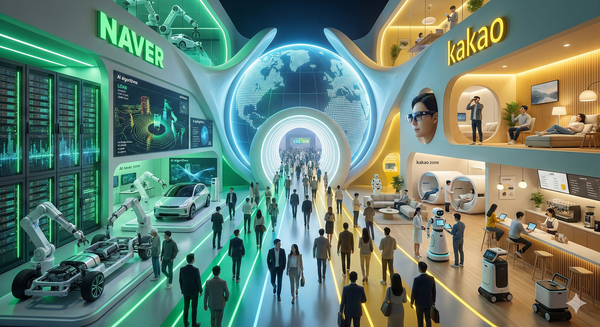
Startups backed by Naver and Kakao will take part in CES 2026, the world's largest IT and consumer electronics show, to be held in Las Vegas from Jan. 6 to 9.
Industry sources said on Jan. 1 that 16 teams will appear, including 9 from Naver D2SF and 7 from Kakao Ventures. Six of them have won CES innovation awards, validating their technical completeness. The exhibition is expected to go beyond a simple display of technology and mark a turning point as startups fostered by South Korea's big tech groups secure partnerships and step up business expansion in global markets such as North America and Europe.
Naver D2SF focuses on 'core technologies' such as ambient AI and infrastructure.
Naver D2SF, Naver's corporate venture capital arm, will send 9 teams in infrastructure and AI, fields with a high level of technical difficulty. Yang Sang-hwan, head of Naver D2SF, said more than 80 percent of its overall portfolio is already preparing for global business, showing a strong push to expand overseas.
This year's performance stands out for the 'depth' of the technology. Studiorab, led by its robotics-based automated photo-shooting solution Gency PB, won a Best of Innovation award. Gaudio Lab (audio AI), RebuilderAI (3D generative AI) and Wearable AI (mobility) each won two innovation awards, proving their competitiveness.
The participation of Sauceryx, the most recent investment by Naver D2SF, is also drawing attention. Sauceryx is a home-solution startup based on ambient AI technology that understands a user's situation and context. It uses on-device AI with a single camera and its own large language model to protect privacy. With a North America launch due in the first quarter of next year, it will make its global debut at CES.
In mobility and data infrastructure, Vueron will unveil VueX, a LiDAR AI platform integrating everything from data collection to distribution. GenGenAI will present GenGenSense, a multi-sensor synthetic data generation solution. In healthcare, Seven Point One aims to expand in North America with Alzwin, which measures brain health through a 1-minute voice test.
Naver has shown a systematic push to support these tech startups' expansion into North America. It officially launched Naver Ventures in June and strengthened links between investment and commercialisation, including by holding a local networking event in Silicon Valley in December in cooperation with the Korea Investment Corporation (KIC).
Kakao Ventures targets 'everyday, close-to-home' innovation in health and logistics.
Kakao Ventures will present what it calls practical innovation through 7 portfolio companies, offering solutions to difficult problems in daily life and industrial sites. Rather than simply showcasing technology, the lineup largely consists of solutions that can be applied immediately in areas such as sleep, childcare, logistics and manufacturing.
Digital healthcare stands out. Innovation award winner NeuroTX will unveil Willsleep, an electroceutical platform. The product analyses a user's sleep condition using AI, then stimulates the vagus nerve in the neck to induce sleep without side effects. With a launch due in the first quarter of next year, it is drawing attention as an alternative in North America's sleep market, which has a high dependence on drugs. Portrai will present a drug development solution that uses spatial transcriptomics technology to precisely predict the location of cancer cells, and will seek partnerships with global pharmaceutical companies.
In extended reality and content, companies aiming for global technical standards will take the stage. Retinal will display an optical module for augmented reality glasses that applies its proprietary pin-mirror technology. It is designed to address both bulk and image quality, long-standing limits of existing AR glasses, and to deliver the comfort of regular eyeglasses. Recon Labs will demonstrate Genpresso, an AI solution for 3D content creation that automatically converts text or images into 3D models, and aims to maximise creators' work efficiency.
A range of B2B AI solutions aimed at removing inefficiencies in industrial sites will also appear. Omelet will introduce Oasis, a generative AI-based logistics optimisation solution. It will target global markets with technology that uses AI to automatically solve complex decision-making problems and maximise logistics and delivery efficiency. Confort Lab will help small and mid-sized factories without developers achieve digital transformation through Pota, a no-code manufacturing AX platform. Luman Lab, which operates the childcare platform WeNeed, will also present AI-based services for recording children's growth and providing development information, as it targets North America's edtech market.
Naver focuses on infrastructure while Kakao backs services, showing sharply different investment styles.
The industry is analysing the CES 2026 participant list as showing that the two companies' startup investment tendencies align with the parent groups' growth strategies.
Naver D2SF has a high share of what it calls infrastructure technologies that require advanced core capabilities, including a LiDAR platform (Vueron), synthetic data (GenGenAI), audio technology (Gaudio Lab) and ambient AI (Sauceryx). This matches Naver's strategy of placing importance on securing foundational technologies such as search engines and AI platforms.
Kakao Ventures, by contrast, has a lineup centred on services and applications that solve specific problems in users' lives or in industrial settings, including sleep electroceuticals (NeuroTX), logistics optimisation (Omelet), AR optical modules (Retinal) and content creation (Recon Labs). This is seen as applying Kakao's approach of expanding close-to-home services based on its messaging platform to its startup incubation as well.
As a result, this CES will serve as a test of whether K-startups fostered in different ways by South Korea's two biggest tech groups can win recognition for both technical standards and marketability in major global markets.
An industry official said Naver and Kakao sending a large number of investee companies to CES is not simply for exhibition purposes but a signal of full-scale business expansion aimed at global partnerships and attracting local investment. The official added that companies that won innovation awards this time have already completed technology validation, making it highly likely they will deliver visible results in global markets within the next 1 to 2 years.
 Hojeong Lee
lhj@d-today.co.kr
Hojeong Lee
lhj@d-today.co.kr