
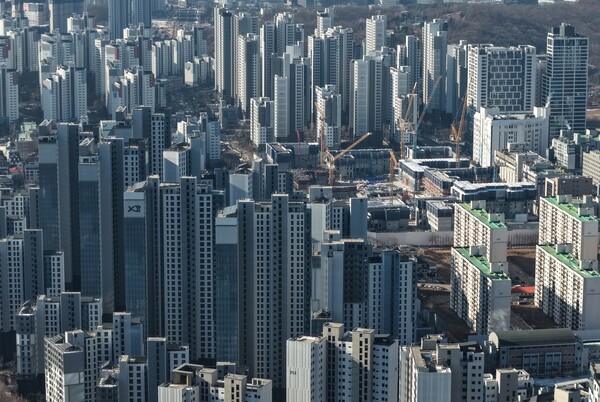
President Lee Jae-myung is delivering a series of hard-line messages to the housing market. His remarks, coming right after the Jan. 29 supply measures, are being read as a signal of tougher policies ahead. Markets are looking for broad pressure that could include tax and lending curbs.
In a recent post on social media, Lee called speculation by owners of multiple homes an "act that ruins the country" and said, "I will definitely catch it no matter what it takes." He believes house price rises driven by property speculation are leading younger people to give up on marriage and childbirth and undermining national competitiveness. He also stressed that, unlike in the past, alternative investment options have increased and public awareness has changed, and that this time he will deliver results.
Pairing supply expansion with messages aimed at curbing speculation is seen as an effort to block expectations of price rises at the source. The assessment is that the government is moving to a two-track strategy: securing medium- to long-term supply while tightening speculative demand in the short term using finance and taxes.
The stance has continued in official settings. At a cabinet meeting held on Monday, Lee said that when investment assets are tied up in property, resources cannot flow to productive areas, distorting the social and economic structure and the allocation of resources. He stressed that if house prices rise unfairly, it will inevitably become a burden for society as a whole.
Financial authorities are also raising their level of alert. Additional regulatory measures to curb the rise in household lending are being placed one after another on the review table.
◆ Move to tighten stress DSR rules
The key is a full expansion of stress debt service ratio (DSR) regulations. The rules currently apply only to mortgage loans, unsecured credit loans and interest payments on some jeonse loans, but a significant widening of the scope is being widely discussed.
In particular, authorities appear to be reviewing a plan to include large jeonse loans and even small loans of 100 million won or less in the DSR. Until now, the rules applied only when total borrowing exceeded 100 million won, leaving relatively small loans as a blind spot. Financial authorities see "debt investing" using this and an increase in borrowing through loopholes. They judge that household debt risks could build up if loans are not managed based on repayment capacity even when amounts are small.
There is also a sense that jeonse loans will be difficult to keep as an exception any longer. If unsecured credit loans are added on top, a borrower’s repayment capacity deteriorates sharply. Authorities are reported to be running simulations on options such as reflecting only interest, not principal, from jeonse loans in the DSR.
Measures to manage mortgage loans separately are also being reviewed. The idea is to move away from focusing only on overall outstanding balances and directly tighten lending flows linked to property. Options being discussed include setting banks’ household lending growth targets lower than last year while managing mortgage lending separately on a monthly and quarterly basis.
In connection with this, Financial Services Commission Chairman Lee Eok-won (이억원) said at a meeting on Jan. 28, "We plan to announce the 2026 household debt management plan in February, and we will set a management target for the entire financial sector that is strengthened compared with last year." He added, "Last year, the growth rate of household loans in the banking sector was about 1.8 percent, and we will strictly manage it so it becomes a little lower than that," and said the final figure would be shared after consultation with related ministries and internal discussions.
The problem is that this trend could impose a considerable burden on end users. There is a strong possibility that borrowing thresholds will rise at the same time for people without homes as they prepare to buy a home while taking on a jeonse contract or seek to stabilise housing by using existing loans.
A financial industry official said, "With the president having declared war on property speculation, financial regulation is effectively the most immediate tool." The official said, "If DSR expansion and total volume management operate at the same time, the lending environment could tighten further than it is now." The official added, "The justification of blocking speculative demand is clear, but if there are no protections for end users at the same time, backlash will also grow."
 Ji-young Lee
ljy@d-today.co.kr
Ji-young Lee
ljy@d-today.co.kr