
As South Korea’s Democratic Party pushes to launch the Broadcast Media Communications Commission in a four-member format in February, attention is focused on the panel’s first agenda item.
On Feb. 4, the commission and industry sources said several forecasts are emerging over what will be the first item.
Academic circles see follow-up rulemaking stemming from amendments to three broadcasting laws as the top priority. An academic official said it would be hard to avoid criticism if the body, designed as a seven-member consensus panel, operates under a four-member government and ruling party system. The official added that follow-up steps to the three broadcasting laws led by Choi Min-hee (최민희) and Kim Hyun (김현) are very likely to become the first agenda item for political reasons.
The three broadcasting laws, which took effect in August last year, increased the number of directors at public broadcasters to 15 for KBS and 13 for the MBC Foundation for Broadcast Culture and EBS, and diversified the recommending bodies. For KBS, six directors are recommended by National Assembly negotiating groups, two by the viewers’ committee, three by employees, two by broadcasting and media-related academic societies and two by lawyers’ groups.
The commission must set rules specifying the names of the “broadcasting and media-related academic societies” and “lawyers’ groups” and the recommendation procedures. Director appointments can proceed only after the commission decides which academic societies, such as the Korean Association for Journalism and Communication Studies and the Korean Association for Broadcasting and Telecommunication Studies, and which lawyers’ groups, such as the Korean Bar Association and the Seoul Bar Association, will receive recommendation rights and how recommendations will be made.
On the programming committee, the law also requires the commission to set rules on the “scope of workers eligible to recommend programming committee members” and “qualification requirements for worker representatives.” A statutory deadline to form a new board within three months of the law’s implementation, Nov. 26 last year, has already passed. Licence and approval periods expired in 2025 for eight operators including four community radio stations and DMB operators and one general programming channel, while those for 12 terrestrial broadcasters including KBS 1TV, MBC and EBS expired in December 2024.
Industry sources pointed to a 63 billion won fine for violations related to bans on forcing in-app payment systems by Google and Apple. An industry expert said it is a top priority because it has been delayed for more than 2 years, but whether it will be handled first is unclear given the current political situation, including trade issues with the United States.
In October 2023, the commission prepared a plan to impose fines totalling 63 billion won on Google, including 42 billion won, and Apple, 21 billion won, but has not executed it for a second year due to a vacancy in the commission’s membership and organisational restructuring. The Telecommunications Business Act prohibits app market operators from using their bargaining position to force a specific payment method.
Within the commission, deliberations over selecting the first agenda item appear to be deepening. A commission official said they are considering the first agenda item, adding that the weight of items that can be handled will differ between a four-member system and a complete seven-member lineup.
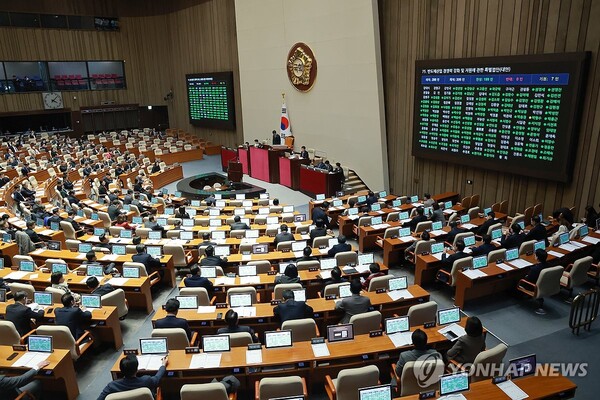
The commission is designed as a seven-member body, with two appointed by the president, two from the ruling party and three from the opposition, and meetings require at least four members present and approval by a majority of those in attendance. If Ko Min-soo (고민수), a professor at Gangneung-Wonju National University recommended by the Democratic Party, as a standing commissioner, and Yoon Sung-ok (윤성옥), a professor at Kyonggi University, as a non-standing commissioner, are appointed after a National Assembly plenary session as early as February, a four-member system will be formed. Still, a full seven-member lineup is needed to match the intended consensus-based structure. Observers say political 부담 would be unavoidable if four government and ruling party figures handle major agenda items on their own.
 Seulgi Son (손슬기)
sageson@d-today.co.kr
Seulgi Son (손슬기)
sageson@d-today.co.kr