
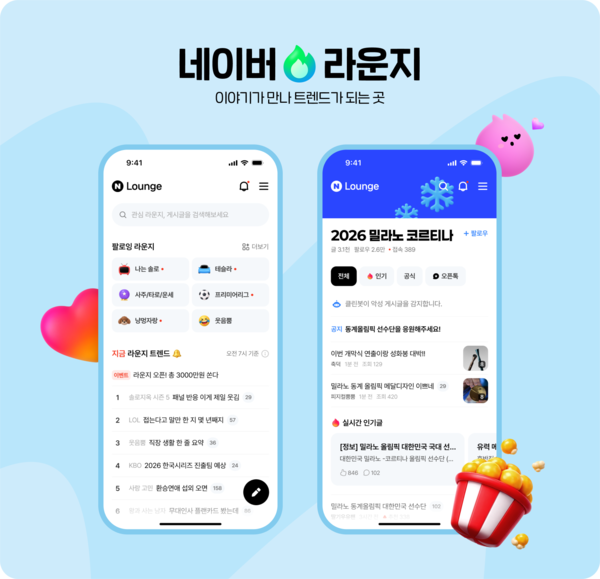
[DigitalToday reporter Lee Ho-jung (이호정)] Naver is moving to reshape the user-generated content (UGC) ecosystem by rolling out Thingsbook and Lounge in domestic and overseas markets. As short-form content and AI summaries proliferate, Naver has instead chosen a strategy that returns to the essence of "human-written posts". This is seen as a step to secure real-time and preference data that will determine the competitiveness of its hyper-personalised AI "AgentN", set to be unveiled in the first half of this year.
Existing UGC services such as blogs and cafes, which have been one pillar of Naver's growth, hold vast amounts of data. But they have been criticised for stagnating in terms of "real-timeness" in responding to the latest trends and immediate issues. Naver has responded by splitting the character of its communities in two to suit user environments and market characteristics.
◆A two-track strategy of 'real-time responses' and 'accumulated preferences'
Naver is no longer competing with a single community model. Thingsbook, which began an open beta in the North American market on Jan. 26 local time, is a repository of "slow records" where individual tastes and experiences build up. Lounge, launched in South Korea on Jan. 28, is a venue for "real-time chatter" that captures emotions and immediate reactions in the moment.
Lounge stresses openness, allowing anyone to take part without separate sign-ups, and collects the public's unfiltered voices. Thingsbook, by contrast, is a text-based, archive-style platform that turns users' in-depth context into data. Naver is pursuing a strategy to cover users' entire time axis by combining Lounge, which gathers thoughts of the moment, with Thingsbook, which creates data to understand users' essence.
◆Securing AI fuel that understands 'context' beyond the 'right answer'
Since the spread of generative AI, search has been quickly turning into a "right-answer delivery service". That is also why Naver is again focusing on communities and records. It aims to identify users' "intent" that cannot be known through search alone. In particular, "AgentN", which is set to be unveiled soon, aims to go beyond answering questions to understanding context and predicting and suggesting next actions as a hyper-personalised AI. That requires data that combines users' emotions, preferences and experiences, rather than simple search logs.
Lounge serves as an antenna showing what questions users are asking right now, while Thingsbook becomes a database that explains where that interest came from.
An industry official said, "There are limits to perfectly reflecting each user's context with only the standardised information provided by existing search engines." The official added, "UGC that contains people's real experiences and unique perspectives will become a key asset for AgentN to precisely grasp complex user intent."
◆Domestic 'lock-in' and a North American test of 'data sovereignty'
The market split between the two services is also clear. Lounge is a card aimed at increasing time spent and platform lock-in for domestic users. Centered on 8 topic boards including broadcasting and films, and sports, it is tasked with increasing the time users stay within Naver.
Thingsbook, by contrast, has targeted the North American market from the planning stage. Rather than transplanting a Korean-style blog as-is, it opted for a text-based social networking service (SNS) format familiar to local users. This can be seen as a test to directly secure English-language UGC and seize "platform-level data sovereignty" needed for its AI training in global AI competition.
Ultimately, Naver appears to be placing emphasis on in-depth understanding of users rather than fast content consumption. Lounge and Thingsbook are analysed as a mid- to long-term survival strategy to maintain a portal's status as the platform that holds the most sophisticated user data in the AI era.
Another official said, "In the AI 2.0 era, where quality and context matter more than the amount of data, Naver's simultaneous expansion of its UGC territory at home and abroad is a survival strategy beyond a simple service launch." The official added, "How quickly it embeds high-quality data containing users' experiences and preferences into its own AI models will determine the outcome of future competition with global big tech."
 Lee Ho-jung
lhj@d-today.co.kr
Lee Ho-jung
lhj@d-today.co.kr