
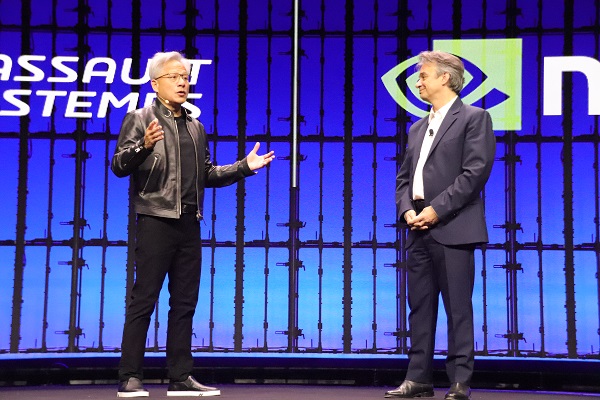
[Houston, United States = Digital Today reporter Chi-gyu Hwang] Manufacturing software company Dassault Systemes and AI computing company Nvidia are joining hands to expand industrial AI.
The focus is on building an industrial AI platform by integrating Dassault Systemes' virtual twin platform with Nvidia's AI computing infrastructure.
The companies on Feb. 3 (local time) officially announced the cooperation at 3DEXPERIENCE World 2026, Dassault Systemes' annual conference held in Houston, Texas.
The partnership will integrate Dassault Systemes' virtual twin technology, which digitises real objects, with Nvidia's computing platform, AI models and CUDA-X software libraries.
This can support various applications across biology, materials science, engineering and manufacturing, as well as an AI-based "virtual companion" embedded in Dassault Systemes' 3DEXPERIENCE platform, Dassault Systemes said.
Dassault Systemes and Nvidia have maintained a partnership for 25 years. It began with support for Nvidia GPUs in Dassault Systemes' CATIA design software and expanded to GPU-accelerated physical simulation using Nvidia's AI development platform CUDA and RTX GPU architecture.
A key part of this collaboration is advancing "physical AI", which can understand and reason about the physical world.
As part of that effort, Dassault Systemes will build "AI factories" using Nvidia infrastructure across three continents through its cloud brand Outscale. This will allow customers to train and run AI models while maintaining data sovereignty, intellectual property protection and compliance, Dassault Systemes said.
Nvidia will adopt Dassault Systemes' model-based systems engineering tools in designing its AI factories. This will apply starting with Nvidia's next-generation AI chip, the Rubin platform, and will also be used in Nvidia Omniverse DSX Blueprints for large-scale AI factory deployment.
The companies' strategy is to build AI systems based on physics, engineering constraints and industrial knowledge, advancing industrial AI beyond the level of a single product. They said this is expected to enable an "industry world model" that can serve as a system of record for designing, simulating and operating complex products and production systems.
The companies also presented industry use cases. In life sciences, Nvidia's BioNeMo platform can be combined with Dassault Systemes' Biovia scientific models for use in drug development and materials research.
In engineering, virtual twins based on Dassault Systemes' simulation solution Simulia and Nvidia CUDA-X libraries will make it possible for designers who are not simulation specialists to predict performance in near real time.
In manufacturing, Nvidia Omniverse physical AI libraries will be integrated with Dassault Systemes' Delmia production-system virtual twins to support autonomous software-defined factories.
Executives at both companies emphasised that the core of the partnership is not the launch of a single product but building a long-term industrial AI framework. They said combining Dassault Systemes' technology for digitally representing the real world with scalable Nvidia AI infrastructure is expected to allow a broad group of experts to use advanced simulation and AI-based decision-making.
 Chi-gyu Hwang
delight@d-today.co.kr
Chi-gyu Hwang
delight@d-today.co.kr